
 Available in US
Singapore Grand Prix Betting: The 100% Safety Car Race
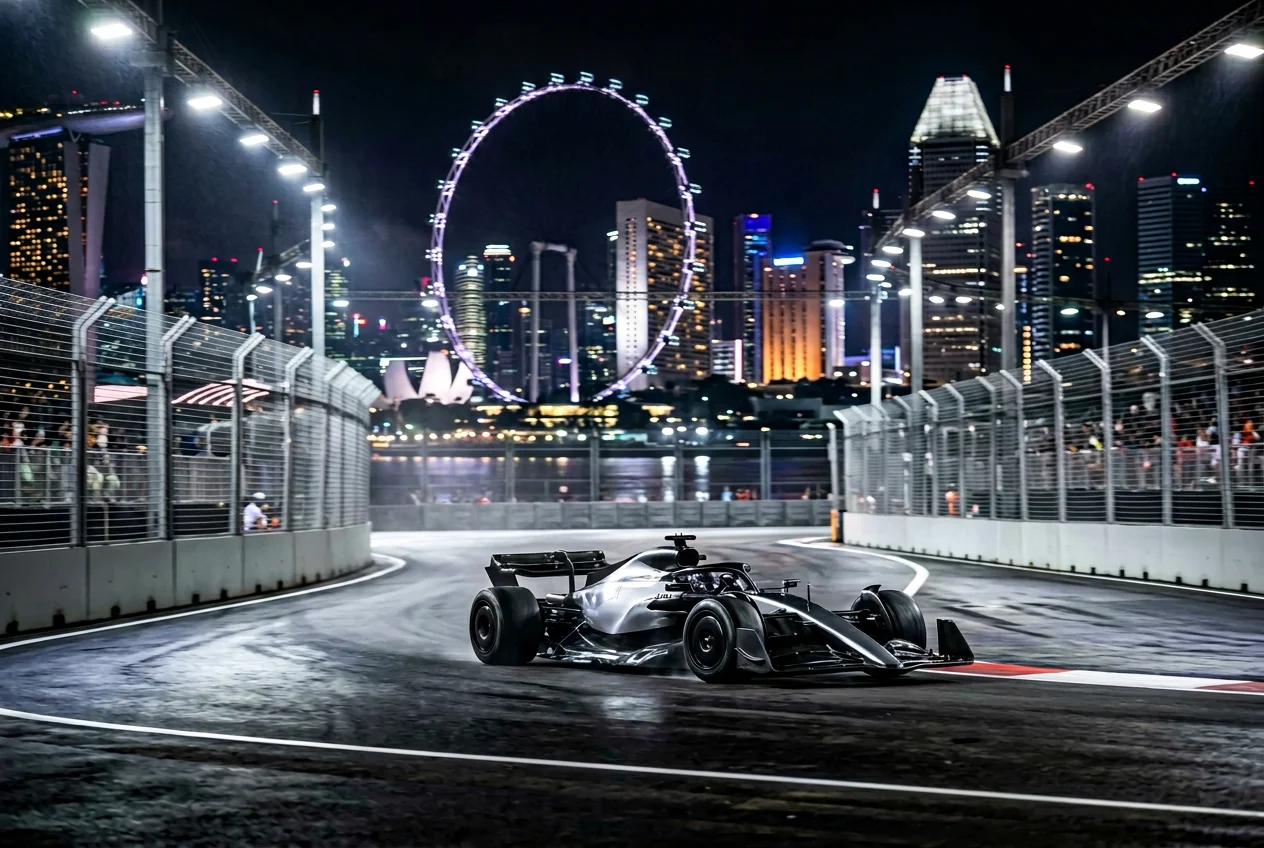
- The only race that has never gone green from start to flag
- The character of a night race that doesn't behave like other night races
- The 100% record and how it bends every adjacent market
- Tyre warm-up and the bets it creates
- Driver fatigue and mid-race retirements
- Questions UK punters ask about Marina Bay
The only race that has never gone green from start to flag
There’s a number I quote almost every September when sprint-keen friends ask me about Singapore: 100%. Every single Marina Bay Grand Prix in the entire 14-year history of the event has produced at least one full safety car deployment, with an average of 1.71 deployments per race. No other round on the calendar gets close to that consistency. It’s the only race I’d describe as structurally guaranteed to produce a yellow flag, and that guarantee bends every market on the weekend.
What this means in practical terms is that a Singapore betting strategy that ignores the safety car is essentially using a 14-circuit model on a 13-circuit calendar. Pre-race pace mapping, qualifying H2H, race-winner pricing — every market downstream is influenced by the safety car arriving at some point on Sunday night. The interesting question is no longer “will the safety car come out?” It’s “when, and what does that do to the markets I’ve staked?”
For UK punters, Marina Bay rewards a different reading framework than any other race. The base assumptions that work in Bahrain or Silverstone don’t apply here, and the operators that don’t fully internalise that fact leave systematic value on the table.
See also: f1 bet for circuit-specific betting guides.
The character of a night race that doesn’t behave like other night races
Marina Bay is a slow-average-speed street circuit run under floodlights in 30-degree heat with 70-80% humidity. Those three variables — speed profile, lighting, and physical conditions — combine to produce a race that’s mechanically and physically the toughest on the calendar.
The slow average speed matters because tyre temperature stays in a narrower band than at high-speed circuits. The lighting matters because it produces no glare on the visor but does flatten depth perception in specific corners, particularly through the bridge section. The humidity matters because driver heart rate stays elevated above its normal race-day range across the entire 90-plus-minute duration, and physical mistakes accumulate as the race progresses.
All three factors push the safety car rate higher than the street-circuit base rate alone would predict. Drivers’ margins shrink as the race goes on, while the walls don’t move. Mid-race errors become more frequent in the second half of a Marina Bay race than in the first half, which is the opposite of most circuits where opening-lap incidents dominate the safety-car-cause distribution.
The 100% record and how it bends every adjacent market
I want to dwell on the 1.71 deployments per race number, because it’s the workhorse statistic of the entire weekend. Across 14 editions, 24 full safety cars have been deployed in total. Not virtual safety cars. Not red flags. Full deployments with the safety car physically on track and the field bunched up behind it.
That base rate produces three derived effects that the markets don’t always price honestly. First, race-winner pricing should reward drivers who manage restarts well, because each safety car deployment is a restart opportunity. The polesitter benefits less than they would at a circuit where the safety car is unlikely to appear. Second, podium-finish pricing on mid-grid drivers is structurally more generous at Singapore than at almost any other round, because the safety car windows create pit-strategy lottery opportunities. Third, pit-stop count markets are sharper at Singapore because the safety-car-triggered free pit stops change the strategic calculation in ways the books often handle conservatively.
The pit-stop market is the one I’d point new bettors at first. The combination of high tyre wear from elevated track temperatures and the high probability of a safety car window opens up two-stop strategies that would be uneconomic on most other tracks. Pre-race two-stop pricing at Singapore has been my most reliable annual edge for the past four seasons.
Cross-operator pricing dispersion at Singapore is also genuinely wider than the season average. The 5-15% baseline spread between UK books tends towards the upper end of that range on Marina Bay weekend, because operators handle the structural volatility differently. Some books price defensively across all markets; others lean on the historical base rate and produce sharper individual lines. Line shopping at Singapore pays the highest annual dividend of any round I track.
Tyre warm-up and the bets it creates
The tyre-warm-up factor at Singapore is genuinely different from anywhere else, because the elevated track temperature flips the usual compound-choice logic. Hard tyres struggle to come into operating window for a meaningful portion of the opening lap, particularly for cars starting deeper in the grid where slipstream effects from the cars ahead disrupt rear tyre temperature.
Mario Isola, who runs Pirelli’s motorsport programme, has put it bluntly about Singapore in particular: “if someone is struggling a little bit with the tyre warm-up, starting on the hard probably creates an additional difficulty at the start of the race. Everyone wants to keep the track position here, so it is possible for people that are in the back of the grid”. That observation translates directly into a betting framework. Drivers starting on the hard compound from the back of the grid have a higher implied incident rate over the opening five laps than the books typically price.
The market expressions of that dynamic are the first-retirement market and the lap-1 incident market. UK operators that offer both at Singapore consistently misprice the implied probability of an early DNF for back-of-grid hard-compound starters. The first-retirement market sometimes carries pre-race lines of 20/1 and longer on these specific driver-compound combinations, when the historical data suggests something closer to 12/1 would be fair. That’s longshot territory in stake size, but the implied EV holds up over a long enough sample.
Driver fatigue and mid-race retirements
The mid-race retirement pattern at Singapore is the variable that distinguishes it most from other safety-car-heavy races. At Monaco or Baku, most safety cars come from opening-lap incidents. At Singapore, the distribution is more even across the race duration, with a meaningful cluster in laps 30-50 that’s specific to Marina Bay.
The cause is driver-physical rather than mechanical. Heart rate elevation, humidity, and concentration fatigue produce small inputs that wouldn’t matter at Silverstone or Spa but do matter when the walls are inches away. The mistakes accumulate. By lap 40, the driver pool is meaningfully more error-prone than it was at lights-out.
The betting expression of this is the lap-bracket retirement markets, where UK operators occasionally offer “next retirement in laps 30-40” or similar bracketed lines. These are operator-specific and not always available, but when they are, the implied probability on the mid-race bracket at Singapore is structurally underpriced relative to the historical distribution of DNF timings.
The same general principle — that opening laps don’t dominate the SC distribution the way they do at other circuits — also informs the broader question of how to read the early-race signals that precede a safety car deployment, which becomes particularly relevant when the entire 90-minute race window is structurally hazardous rather than just the first ten minutes.
See also: Saturday grid positions often decide Singapore — read our qualifying betting strategy.
Questions UK punters ask about Marina Bay
Is the SC market overpriced at Singapore?
Rarely. The 100% historical deployment rate means yes-SC pricing at Singapore tends to sit short — often 1/2 or shorter — and on the surface looks like a market without value. The genuine edge isn"t in the yes-or-no market but in the count-of-safety-cars line, where 1.71 deployments per race historically means the over-1.5 SC market often offers value at evens or longer, depending on operator pricing assumptions.
Should I avoid podium bets on tyre warm-up issues?
Not avoid, but adjust. Drivers starting on hard compound from outside the top 10 are statistically more likely to be involved in opening-lap incidents at Singapore, which lowers their podium implied probability further than the books sometimes price. The fade is the right call on those specific driver-compound combinations. Conversely, drivers starting on medium or soft compound from mid-grid spots can be backed at longer prices than the implied tyre-advantage would justify.
