
 Available in US
F1 Betting App Features UK: What to Look for Beyond the Marketing
The features that actually decide the bet, not the ones in the adverts
The marketing copy for every UK betting app reads roughly the same: fast, simple, great odds, top features. The reality on race day is far more varied. I’ve used most of the mainstream UK F1 betting apps across the last several seasons, and the difference between the best and worst of them is not subtle. The features that matter for serious F1 betting are typically the ones the marketing doesn’t lead with, and the features the marketing lead with are typically the ones that don’t matter much when the lights go out on a Sunday afternoon.
The mobile shift is the structural driver. UK online betting gross gambling yield reached £1.42 billion in Q2 2025, an 8% year-on-year rise, with mobile migration as the main growth driver. Operators have invested heavily in app development as a result, but the investment hasn’t been uniform across feature categories. Some apps are excellent at fast bet placement and poor at responsible gambling tool access. Others have detailed live timing widgets and clumsy push notification design. The apps that are genuinely strong across all the categories that matter are a small subset of the available options.
The categories below are the ones I’d assess any UK F1 betting app against. Marketing-led feature comparisons miss most of them. Real-world F1 betting tests every one of them.
See also: f1 bet for mobile and desktop betting resources.
The core in-play feature checklist
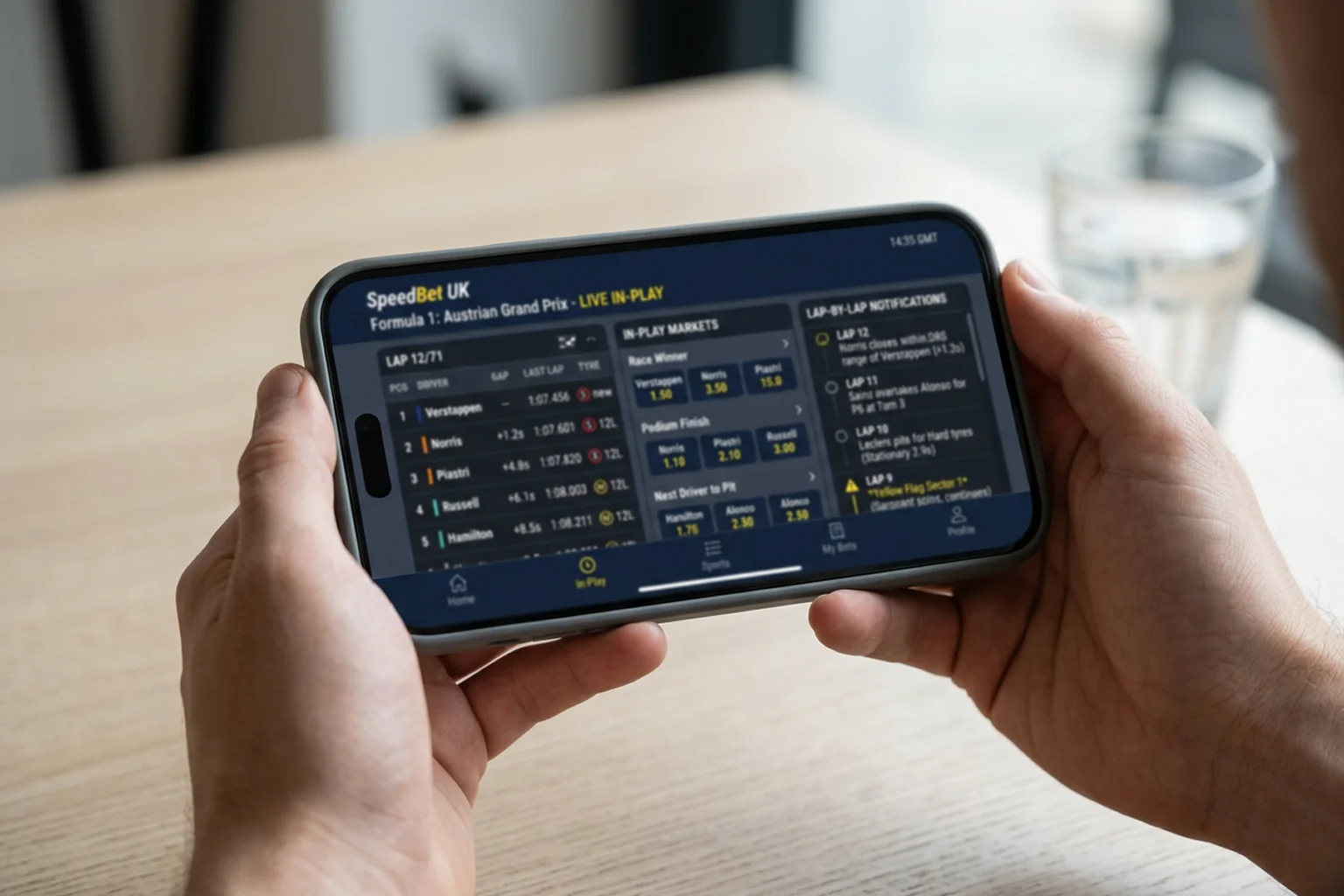
Live timing data is the single feature that separates serious F1 betting apps from casual ones. A betting app that doesn’t surface lap-by-lap sector times, gap-to-leader data, and tyre information in a usable in-app widget is structurally disadvantaged for in-play F1 betting, because the punter has to switch to a separate timing source between bet placement decisions. The latency cost of switching apps is meaningful in a market where prices move on five-to-ten-second windows.
The implementation quality varies hugely. The best UK F1 betting apps include integrated live timing as a default panel within the race-day market view. The worst require the user to manually open a separate page or accept significantly delayed timing data. The difference between best and worst across this single feature is more practically significant than any difference in headline odds, because timing data quality directly affects the punter’s ability to make informed in-play decisions.
Push notifications are the second core feature. UK operators differ significantly in how they configure race-day push notifications. The best implementations push contextual alerts — “safety car deployed”, “pit window opening”, “fastest lap shifted” — rather than generic promotional content. The worst implementations are essentially marketing pushes dressed in racing language. The configuration usually lives in the app settings menu and is worth reviewing before any race-day session.
Quick-bet functionality is the third feature. A bet that takes 20 seconds to place is a bet that may have moved against the punter by the time it confirms. The fastest UK F1 apps allow one-tap bet placement on pre-configured markets, with the stake size pre-set and the confirmation dialogue minimised. The slowest require multiple screen transitions and stake-entry steps that add seconds to every in-play decision. For a punter who places multiple in-play stakes during a typical race, the per-bet time cost adds up to meaningful exposure to price slippage.
Streaming and broadcast rights inside the apps
The UK F1 streaming landscape inside betting apps is constrained by the Sky exclusive broadcast rights structure. Sky’s UK F1 partnership produced 162 million viewer hours across the 2025 season — a record figure — and the exclusivity means that direct F1 race streaming inside UK betting apps is not generally available. The licensing structure simply doesn’t permit it.
What UK betting apps can and do offer instead is a combination of secondary content: live timing visualisations, race position graphics, integrated commentary feeds, and sometimes free-to-view highlights packages. The quality of this secondary content varies meaningfully. The best apps make in-app race tracking genuinely useful for users who are watching the broadcast separately. The worst offer minimal secondary content and effectively require the user to have a Sky subscription or another broadcast source running alongside.
The strategic implication for UK F1 punters is that the betting app is unlikely to replace the broadcast feed as the primary viewing source. The two run in parallel, and the value of the betting app’s secondary content depends on how well it complements the broadcast rather than substituting for it. Apps that synchronise their in-app widgets to broadcast timing within an acceptable delay window are more useful than apps that present data faster but in a way that’s disconnected from what the user is seeing on screen.
The feed latency between betting app data and broadcast data is itself a strategic variable. The operator’s internal data feed is typically faster than the broadcast — sometimes by several seconds — which means the market has reacted to incidents before the user sees them on screen. The apps that surface this asymmetry transparently, including showing the timing of data updates, are more useful for in-play decision-making than the apps that present data without context.
Responsible gambling tools and their accessibility
The accessibility of responsible gambling tools inside UK betting apps is one of the under-discussed quality variables. Every UKGC-licensed operator is required to provide deposit limits, time-out, reality checks, and integration with GAMSTOP. The structural requirement is uniform. The user-interface implementation is not.
The best UK apps surface responsible gambling tools in the main account menu with a single tap from the home screen. The worst bury them three or four taps deep, in settings sub-menus that require the user to know exactly where to look. The depth of the menu structure is itself a meaningful indicator of how seriously the operator treats responsible gambling — the operators who place the tools prominently are signalling that they expect users to engage with them as routine infrastructure rather than as exceptional intervention.
Reality check configurability also varies. The default settings on most apps are typically 30-minute or 60-minute intervals. The best apps allow users to customise the interval to shorter periods if they wish — 15 minutes during particularly intense in-play sessions, for example — without restrictions. The worst apps lock the user into the default interval or require multiple confirmation steps to adjust it.
Deposit limit adjustment speed is regulated centrally — tightening takes effect immediately, loosening requires a 24-hour cooling-off period — but the user experience around the adjustment varies. Apps that make tightening genuinely friction-free and loosening appropriately frictional are aligned with the regulatory intent. Apps that make both equally frictional, or that make loosening surprisingly easy, are technically compliant but practically less supportive of disciplined use.
App performance traps that affect race-day betting
The performance issues that matter for F1 betting are specific to the race-day pattern of high-volume in-play activity, and they appear in the apps that aren’t optimised for that pattern. The bet slip freeze is the most common failure mode. An app that becomes unresponsive at the moment a punter is trying to place an in-play stake — typically because the operator’s servers are under high load from many users placing similar bets simultaneously — produces real cost for the user even if the app eventually recovers.
The latency between bet placement and confirmation is the second performance variable. A bet that’s been tapped but not yet confirmed is in an ambiguous state — the punter doesn’t know whether the price will be the price shown at confirmation or a refreshed price after the operator has adjusted. The best UK apps provide near-instantaneous confirmation; the worst can leave the user in an ambiguous state for several seconds, which on a fast-moving in-play market can be the difference between a winning and a losing bet.
The handling of price changes during the bet placement process is the third variable. Some operators automatically accept any price change during the bet placement window, meaning the user might pay a worse price than they thought they were taking. Others reject the bet if the price moves against the user, requiring a manual re-confirmation. Others provide a configurable tolerance — accepting price moves within a defined percentage and rejecting larger changes. The configuration matters because it determines whether the user maintains control over the prices they actually take.
The line-shopping question is closely related, because app performance varies meaningfully across operators and the practical workflow of comparing prices across multiple apps depends on each app behaving consistently. The broader picture of how to actually compare F1 odds across UK bookmakers and where the 5-15% price gaps live is the natural companion to any review of app features, because the app is the practical interface through which line shopping happens.
See also: boost returns on longer odds with F1 each-way betting in the UK.
UK F1 betting app questions that come up
Can I stream F1 live in a UK bookmaker app?
No, generally not. The Sky exclusive UK F1 broadcast rights structure means live F1 race streaming inside UK betting apps is not commercially available. What apps can and do offer is a combination of live timing visualisations, race position graphics, integrated commentary feeds, and occasional free-to-view highlights packages. The practical implication is that UK F1 punters typically run their betting app in parallel with a Sky-based broadcast source rather than relying on the app as a primary viewing channel.
Which app features actually matter for in-play F1?
Live timing data integrated into the in-app market view, configurable contextual push notifications for race events like safety car deployment and pit windows, fast bet placement with minimised confirmation steps, and reliable performance under race-day server load. These are the features that determine the practical quality of an F1 betting app for serious in-play use. Headline odds matter too, but the structural features above determine whether the punter can actually act on the prices they see before the market moves.
