
F1 Bet UK: Complete 2026 Guide to Formula 1 Markets, Odds and Bankroll Discipline
 Start Reading
Loading...
- What this guide gives you
- The UK regulatory landscape every F1 bettor lives inside
- Who actually bets on Formula 1 in the UK
- How F1 odds work, and why two operators rarely agree on the same number
- The core F1 betting markets, mapped to how a race actually unfolds
- How the 2026 regulations reshape every price on the board
- Pre-race versus in-play: the Grand Prix weekend as a betting workflow
- A bankroll and staking framework that survives a full F1 season
- Choosing a UK bookmaker for F1 without falling for a top-ten list
- Responsible gambling when a single race lasts ninety minutes
- Frequently asked questions about F1 betting in the UK
- Treating Formula 1 betting as a multi-season discipline
I still remember the first F1 ticket I ever wrote down on a betslip — Silverstone 2017, a clumsy each-way on a midfield car that was never going to see a podium, and I genuinely believed I had cracked the maths because the price looked "big". Eight seasons of strategist work later, I can tell you the entire UK F1 betting market in one sentence: it is wagering on Formula 1 through UK Gambling Commission-licensed operators, priced in pounds, structured around drivers and constructors rather than the home-or-away logic of football, and shaped by a regulator that has become noticeably more interventionist in the last twenty-four months.
That structural quirk matters more than people think. There is no 1X2 in F1. There are twenty drivers, ten constructors, twenty-four Grand Prix weekends, six Sprint events, and a points table that runs from March to December. You are not picking a winner from two sides — you are pricing a field, and the field rewrites itself every fortnight.
The audience driving this market is also no longer niche. Formula 1's UK and Ireland viewership has grown by roughly ninety per cent since Sky took exclusive rights in 2019, the under-thirty-five segment has more than doubled, and the country now sits on a fanbase of 16.7 million people. The 2025 season delivered 162 million viewer hours on Sky alone — a record for the partnership.
16.7M
UK F1 fanbase, 2025
+90%
UK & Ireland audience growth since 2019
162M
Sky UK viewer hours, 2025 season
This guide is written for the bettor that audience growth is creating: a relatively new entrant who watches every race, understands tyre compounds better than most pundits, and is now trying to translate that fluency into bets without getting eaten alive by margins, regulation shifts, and their own enthusiasm. We cover what is legal in the UK, how odds actually work, which markets repay study and which are traps, how the 2026 regulations are rewriting prices in real time, and — most importantly — how to bet on twenty-four weekends a year without quietly demolishing your bankroll by July.
What this guide gives you
- The full map of F1 betting markets in the UK — race winner, podium, fastest lap, head-to-head, championships, points-finish, safety car — with the maths and the FIA rules that actually settle them.
- Why fractional odds dominate UK F1 lines, how to convert 4/6, 10/1 and 13/4 into implied probability, and why the same driver can carry a five-to-fifteen-per-cent price spread across operators.
- How the 2026 power unit rules — the 50/50 hybrid split, the MGU-K Override, the thirty-per-cent downforce cut — are pumping volatility into outright and race-winner markets across the opening rounds.
- A working bankroll framework: weekly exposure capped at five to seven per cent of the bank, 0.75 to 1.0 units on core wagers, 0.1 to 0.3 units on longshots.
- A pre-race and in-play workflow built around the actual weekend — FP3, qualifying, formation lap — and what the UKGC's responsible gambling tools require you to do before you sign up.
The UK regulatory landscape every F1 bettor lives inside
Ask any UK bettor under thirty when they last read a piece of gambling legislation, and you will get a polite shrug. Ask them whether they noticed their favourite slot stake dropping to a fiver in April 2025, and suddenly everyone remembers. Regulation in this market is rarely abstract — it shows up in your account.
British F1 betting sits inside one of the most heavily supervised gambling regimes in Europe. The UK Gambling Commission licenses every operator you can legally use from a UK address, sets minimum age at eighteen, and over the past two years has shifted from a fairly hands-off posture into something closer to active steering.
UKGC — the UK Gambling Commission, the statutory regulator created under the Gambling Act 2005 that licenses operators, enforces compliance, and publishes the operator and participation data this guide relies on.
GGY — Gross Gambling Yield, the industry's standard revenue measure: total stakes minus winnings paid out. When the UKGC reports £1.45 billion in online GGY for a quarter, that is the money operators kept after settling bets.
The most visible 2025 intervention is the new online slots stake cap. From 9 April 2025, the maximum stake per spin on online slots is £5 for anyone aged twenty-five or over, dropping to £2 for the 18–24 age band from 21 May 2025. F1 betting itself is untouched — slots and sports books are different licensed products — but the principle matters. The Commission has shown it will set hard limits on individual products where it sees concentrated harm.
"There has been a lot of recent commentary about financial risk assessments and sadly much of it has been ill-informed or inaccurate," Helen Rhodes, the UKGC's Director of Major Policy Projects, wrote in April 2026 — a polite reminder that the checks are still in pilot, still light-touch for ordinary punters, and not the credit-reference apocalypse some tabloids billed them as.

The other axis of the 2025 reset is the black market. UK illegal stakes are now estimated at £16.6 billion annually by H2 Gambling Capital, almost three times the 2019 level, and the Treasury has allocated roughly £26 million in additional funding over three years to help the Commission chase unlicensed sites. The regulator's bandwidth for chasing offshore books is finally growing — useful for F1 bettors specifically, because motorsport books are a favourite vehicle for offshore operators given the global calendar.
What to check before you fund an account — a UKGC licence number visible on the operator's footer, a UK-registered support address, GAMSTOP enrolment, and the words "BeGambleAware" clickable to the safer-gambling charity. If any one of those is missing, close the tab.
One last piece of the regulatory furniture: the Premier League's voluntary withdrawal of gambling sponsorship from the front of shirts from the end of the 2025/26 season. F1 itself is unaffected, but it tells you which direction the political wind blows. Sponsorship is contracting at the consumer-facing edge; product regulation is tightening; financial risk checks are inching closer to live deployment. None of this kills F1 betting in the UK. It defines the operating environment in which every recommendation in this guide makes sense.
Who actually bets on Formula 1 in the UK
A friend who runs trader training for a mid-tier UK book told me last spring that he had stopped using "the typical F1 punter" as a teaching example because nobody in his classroom could agree what one looked like any more. That is roughly the right starting point. The UK F1 audience in 2026 is a moving target — younger, more female, more globally fluent than any motorsport audience the country has ever had.
43%
of global F1 fans now under 35
90%
emotionally invested in race outcomes
86%
watch 16 or more races per season
The Sky-era growth numbers reset every assumption about who is placing F1 bets in the UK. Total viewership in the UK and Ireland is up roughly ninety per cent since 2019, the under-thirty-five band by roughly one hundred and twenty per cent, and the female audience has more than doubled. The demographic is converging on the F1 global picture, where forty-two per cent of fans are women — up from thirty-seven per cent in 2018 — and forty-eight per cent of all new fans gained over the last year are women.
What this means in the betslip is straightforward. The UK F1 bettor of 2026 has watched the Drive to Survive feedback loop, follows three to five drivers on social media, knows whether Pirelli brought C2-C3-C4 or C3-C4-C5 to a circuit, and forms a view on tyre strategy before the formation lap. That competence baseline did not exist a decade ago, and operators know it — the depth of in-play markets on F1 has expanded specifically because the punter base is informed enough to bet on micro-events.
The intensity of engagement is the other defining feature. The 2025 Global F1 Fan Survey put ninety per cent of fans as emotionally invested in race outcomes, with sixty-one per cent consuming F1 content daily and eighty-six per cent watching sixteen or more races per season. "This survey isn't just a snapshot — it's a signal to the marketplace. Gen Z, women, and US fans are driving an always-on, connected, and culturally powerful era for F1," Werner Brell, CEO of the Motorsport Network, framed the result. From a betting-discipline standpoint, that intensity cuts both ways. Daily content consumption produces informed bettors. It also produces bettors who are emotionally exposed to the result of every single Grand Prix.
Among the 290 million online bets placed each month in the UK, men account for sixteen per cent of all four-week sports-or-racing betting participation, women for four per cent. F1 itself is gender-converging fast at the viewership level, but the betting gender gap is closing more slowly.
One last piece of audience data worth a punter's attention: the 2025 British Grand Prix drew five hundred thousand spectators across the weekend at Silverstone, with one hundred and sixty-eight thousand on race day alone — a new circuit record. That physical presence translates directly into a domestic appetite for Silverstone-specific markets, weather props, and home-driver each-way wagers, all of which operators price with a noticeable patriotism premium.
How F1 odds work, and why two operators rarely agree on the same number
The cleanest way to lose money on F1 is to bet at the first price you see. I spent the best part of 2019 doing exactly that, and the bookkeeping at the end of the season told a story I could have read off a calculator: the same driver, on the same race, was priced five to fifteen per cent apart across the three operators I had accounts with — and I had backed him at the worst price almost every time. That spread is the single most exploitable feature of the UK F1 market.
UK operators default to fractional odds, a quirk of British betting culture. Decimal is available on every major sportsbook, usually toggleable in account settings, and most serious bettors flip to decimal the moment they open an account. Both formats describe the same thing — the return per unit staked — but decimal is easier to do in your head, and implied probability falls out of it directly.
The translation, once and for all
Fractional 4/6 means you win four pounds for every six staked. As a decimal, that is 1.67 — your six-pound stake returns ten pounds total, including the stake back. Implied probability is one divided by the decimal, so 1.67 implies a sixty per cent chance of winning. Fractional 10/1 is decimal 11.0 and implies roughly nine per cent. Fractional 13/4 is decimal 4.25 and implies just under twenty-four per cent.
Why does the same driver carry different prices at different books? Two reasons, both structural. First, every operator builds a margin — the "overround" — into the implied probabilities of a market. The probabilities of all twenty drivers winning a Grand Prix should sum to one hundred per cent. In a typical UK book they sum to one hundred and ten to one hundred and twenty per cent, with the difference being the operator's commission. Second, individual books have positional risk: a book that has taken heavy money on the favourite will shorten his price to discourage further exposure and lengthen his nearest rival to attract balancing money. Multiply both effects across twenty drivers and you get the five-to-fifteen-per-cent spread the F1 market routinely shows.
Race winner, midfield driver
10/1 fractional → 11.00 decimal → 9.09% implied probability. £20 stake returns £220 total (£200 profit + £20 stake) if the bet wins.
Podium finish, dark-horse driver
13/4 fractional → 4.25 decimal → 23.53% implied probability. £25 stake returns £106.25 total (£81.25 profit + £25 stake) if the driver finishes in the top three.
The implied-probability conversion is the bettor's actual working tool. Once you can convert a price into a probability in your head, you can compare what the book thinks against what you think. If your view is that the dark-horse podium is forty per cent likely and the book is offering 13/4 implying twenty-four per cent, that is a value bet. If you cannot articulate why your number diverges from the book's, you do not have a value bet — you have a feeling.
| Market | Typical low price | Typical mid price | Typical high price | Spread |
|---|---|---|---|---|
| Race winner, top favourite | 4/5 | 5/6 | 10/11 | ~6% |
| Race winner, second favourite | 3/1 | 11/4 | 10/3 | ~11% |
| Podium finish, third-string driver | 7/2 | 3/1 | 4/1 | ~14% |
| Fastest lap, midfield | 16/1 | 14/1 | 20/1 | ~15% |
That table illustrates the typical price band rather than naming books — the spread widens as you move from heavy favourites into mid- and longer-priced selections. Heavy favourites have so much money flowing in that books cluster around the same price. Longer prices have less informed money behind them and more positional risk per operator. That is exactly the part of the card where having two or three UKGC-licensed accounts pays for itself.
The deep work on overround, true probability, and price-shopping discipline belongs in a dedicated guide. I have written it up under how F1 betting odds work in the UK, including the calculator templates I use mid-weekend.
The core F1 betting markets, mapped to how a race actually unfolds
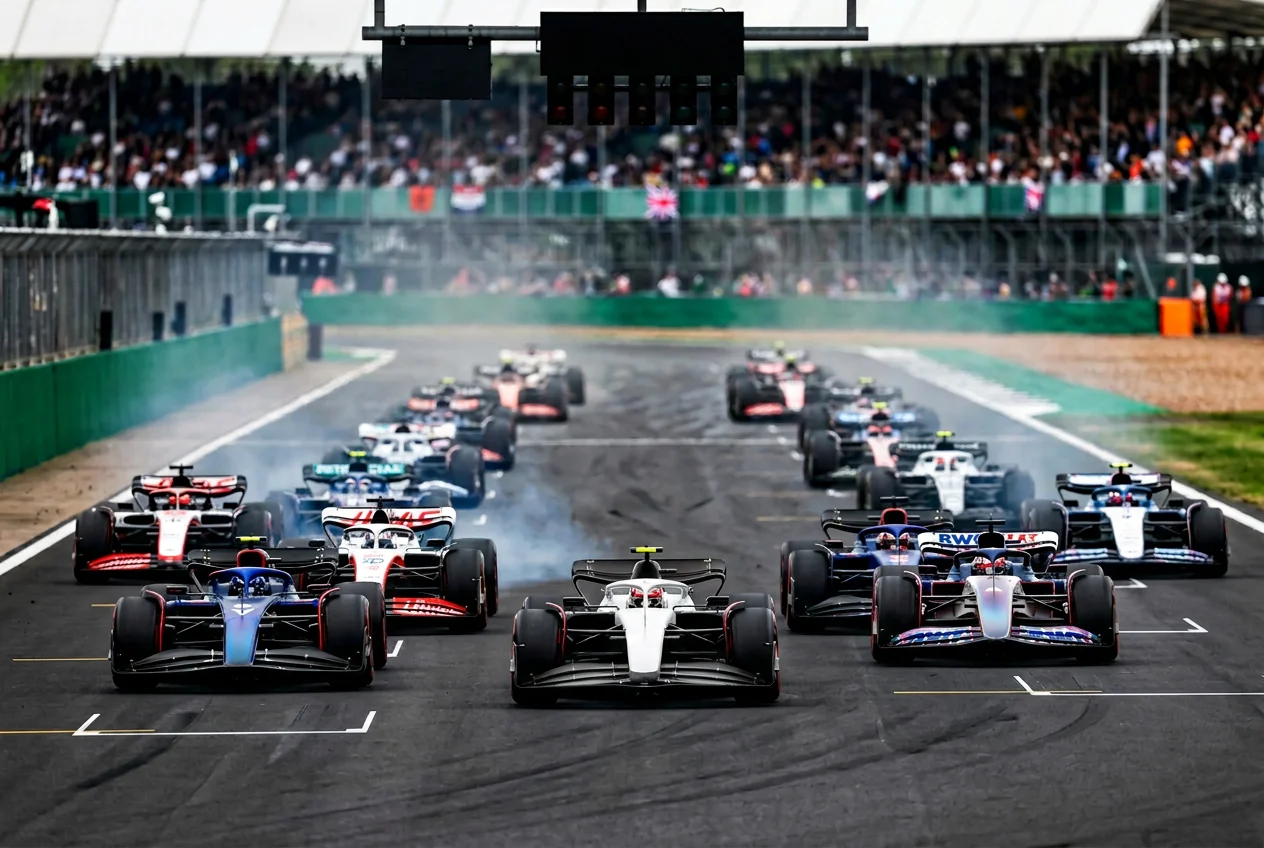
The first time someone showed me a full F1 betting card during a Practice 3 session in Monza, I counted more than seventy individual markets on a single race. The card has only grown since. To navigate it, you need a mental model that maps markets onto what is actually happening on track — qualifying, the start, the race, the chequered flag, the championship.
Race winner
The driver crossing the line first. Favourites trade between 4/6 and 3/1 in normal conditions.
Podium finish
Driver finishes in the top three regardless of position. Roughly three times the implied probability of an outright win for the same driver.
Fastest lap
Highest single-lap pace; often hunted by midfield runners on fresh softs in the closing laps when the lead is settled.
Head-to-head
Pick the higher finisher between two specified drivers, often teammates. Settlement is robust to DNFs.
Championship outrights
Season-long markets on the Drivers' and Constructors' titles. Long holds, big variance.
Safety car / first retirement
Prop markets covering whether an SC is deployed, when, and which driver fails to finish first. Heavy circuit-dependence.
Race winner and podium finish
Race winner is the gateway market and the one that gets new bettors into trouble fastest, because it looks like the football match-winner and behaves nothing like it. There is no draw, the field is twenty cars deep, and reliability failures suppress the favourite hit-rate well below what the typical 4/5 to 4/6 implied price would predict.
Podium finish is the natural companion market and, in my notebook, the better risk-adjusted product for most weekends. Implied probabilities for a frontline driver sit around sixty to seventy-five per cent. Podium removes the binary "first or nothing" exposure — a driver crippled in the second stint by a slow stop can still recover to a podium where they cannot recover to a win.
Classified finisher — under FIA Sporting Regulations, a driver must complete at least ninety per cent of the race distance, measured by the winner's distance, to be officially classified. This rule is the settlement backbone of podium, points-finish and head-to-head markets.
Head-to-head matchups
Head-to-head is where information edge matters most and where the casual punter is most often outpriced by their own confirmation bias. A good H2H is structural: teammates in the same car, where qualifying pace and tyre management are the only real variables; or two evenly matched cars where one has a clear circuit-specific advantage. A bad H2H is two drivers from different teams whose underlying car performance you have not modelled.
UK books typically offer between fifteen and thirty H2H lines on a race weekend. H2H is robust to DNFs in most operator settlement rules — if one driver retires, the other wins by default — which makes it a useful frame for tracking your own analytical edge across a season.
Outright championship markets
The Drivers' and Constructors' outrights are the longest holding period in F1 betting and the market with the most catastrophic variance, because a single mid-season regulation tweak or a single failure run can re-rate the entire board. With four power-unit manufacturers and a brand-new energy-recovery balance, the early-2026 outright prices are drifting wildly between rounds three and eight. Discipline says commit a small unit size early and refuse to chase the price after round five, when the picture clarifies and value evaporates.
Prop markets
Fastest lap, safety car, first retirement, winning margin, pole position, race leader after lap one — the prop universe is huge and getting bigger. Safety car props are circuit-dependent in a way most casual bettors underestimate: Singapore has a one hundred per cent historical SC deployment rate, Monaco runs around seventy per cent across the last decade, Bahrain sits closer to fourteen per cent. Pricing these correctly demands circuit-by-circuit data, not gut feel.
Points-finish — top-ten classified — is the underrated prop for serious bettors. It is more forgiving than podium, deeper than race winner, and its settlement is tied directly to the FIA's ninety-per-cent rule.
The full market-by-market breakdown — settlement for partial races, red flags, and disqualifications — is in F1 betting markets explained.
How the 2026 regulations reshape every price on the board
"The biggest challenge is probably that we are starting from scratch on everything — new tyres, new fuel, new engine, new chassis, new sporting regulations — new everything. It's quite challenging." That is Frédéric Vasseur, Team Principal at Scuderia Ferrari, speaking in March 2026. When a competing team principal admits in public that everything has changed at once, you can be confident that no pre-season market on the board is correctly priced relative to its mid-season equivalent.

The 2026 ruleset is the most aggressive technical reset Formula 1 has run since the 2014 hybrid era. Three structural changes drive the betting impact, and they compound each other.
The first is the power unit. The 2026 ICE and electrical components are now balanced at a 50/50 split — half the lap's propulsive energy comes from the ICE, half from the battery. The MGU-K motor-generator has been ramped from 120 kW under the previous rules to 350 kW, roughly 469 horsepower from the electrical side alone. The MGU-H has been removed entirely. Recoverable energy per lap has doubled to 8.5 megajoules.
Why this rewrites the betting board — every regulation change of this magnitude in modern F1 has produced at least one season of disproportionate winner dispersion. The 2009 aerodynamic change handed Brawn a championship from nowhere. The 2014 hybrid change locked in Mercedes for seven years. The 2022 ground-effect rules produced a Red Bull dynasty. Whatever 2026 produces, it will not be the 2025 order untouched.
The second is the aerodynamic package. Downforce is cut by thirty per cent across the board, drag by fifty-five per cent. The cars are narrower and lighter, with active aerodynamic elements replacing the previous DRS system. The Manual Override mode gives the chasing car a 350 kW electrical boost up to 337 kilometres per hour when it sits within one second of the car ahead. This is the regulation that will most visibly affect race-winner and overtaking-related prop markets.
The third is the manufacturer landscape. Four power-unit producers are now active full-stake: Ferrari, Mercedes, Red Bull Powertrains in technical partnership with Ford, and Audi. Honda returns to the grid via its own programme, and General Motors has confirmed a 2029 entry. More manufacturers means more genuine variance — the probability that one team produces a dominant package is materially lower than in a two-manufacturer environment.
Pre-race favourites in the first six rounds of 2026 are priced with significantly more uncertainty than in a stable regulation year. Outright championship lines are particularly volatile until roughly round eight. Discipline says small units early, larger units once the picture clarifies — not the reverse.
What does this mean operationally? Three concrete things. First, race-winner prices for the historic frontrunners will carry wider confidence intervals than usual. Second, head-to-head matchups between drivers in different cars are essentially un-bettable for the first three to four rounds — stick to teammate H2Hs, where both drivers share the same regulatory adaptation curve. Third, prop markets tied to overtaking are likely to be mispriced relative to historical baselines, because the Manual Override changes the physics of overtaking in ways that have no historical comparator.
The full picture of how the 2026 ruleset is moving specific markets, and what to do about it, is in how the 2026 F1 regulations are reshaping betting markets.
Pre-race versus in-play: the Grand Prix weekend as a betting workflow
The Grand Prix weekend is not a single betting event. It is a four-day workflow with at least six discrete pricing moments, and treating it as one big race-day decision is the most expensive mistake I see new bettors make. The card moves between Thursday afternoon and the formation lap, and most of the value moves with it.
"In much of Europe, in-play now accounts for about 70% of sports betting GGY though its market share seems not yet to be quite so large in Great Britain," Professor David Forrest of the University of Liverpool noted in his written evidence to the UK Parliament Select Committee. That observation matters operationally: the UK in-play share is structurally lower than the European average, which means UK F1 in-play markets are still building depth, liquidity is thinner during a live race than in football, and pricing latency between operators is higher. That is an opening for the disciplined bettor — and a trap for the impulsive one.
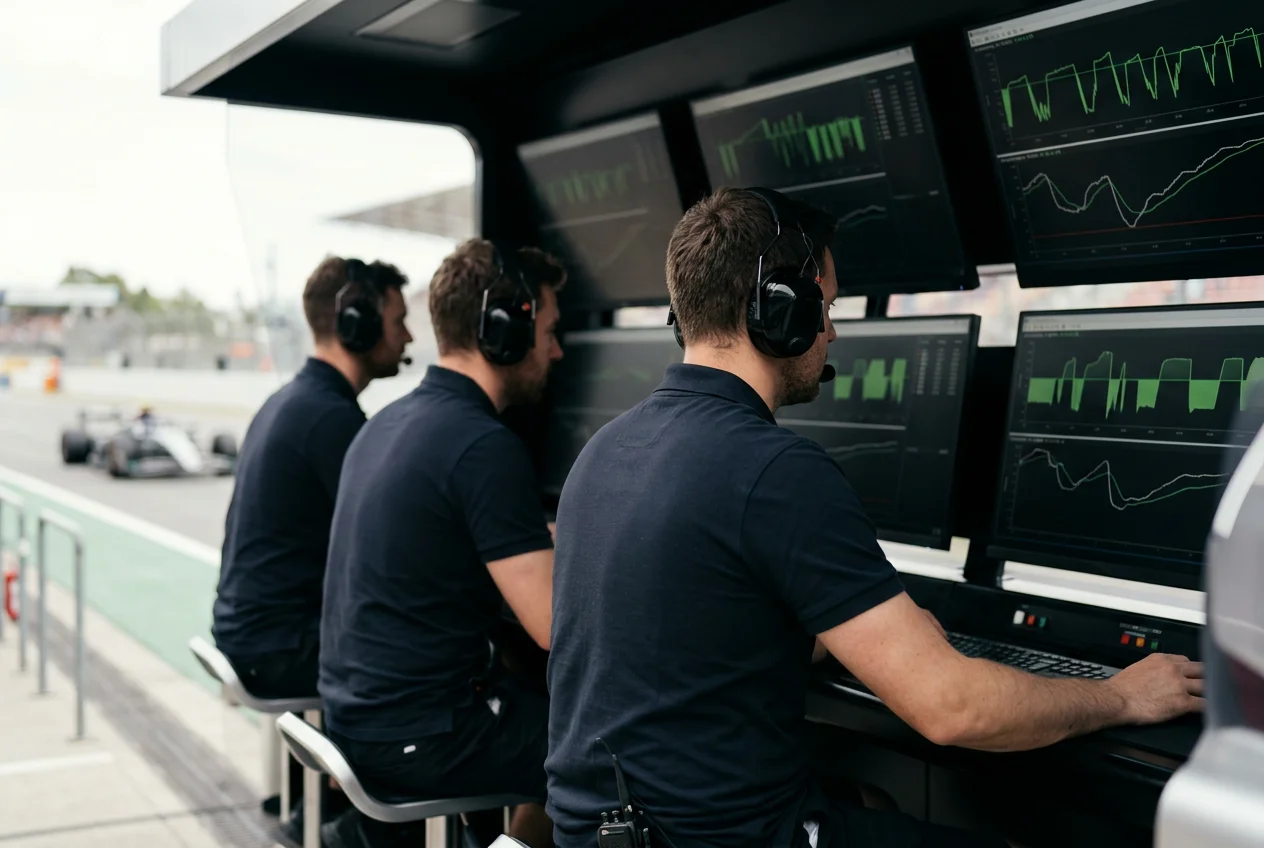
The Grand Prix weekend, mapped to the betting calendar
Thursday afternoon — first opening of weekend-specific markets: race winner, podium, fastest lap, championship props re-rated for the round. Liquidity is thin, lines are conservative.
Friday FP1 and FP2 — practice pace data lands. Books re-rate everything against the running order. Friday pace is noisy and tyre programmes differ wildly between teams.
Saturday FP3 and qualifying — the single most informative window. Pre-race winner prices undergo their largest single move, sometimes shifting twenty to thirty per cent for the pole-sitter alone.
Sunday formation lap to lights-out — last-minute pre-race entry. Weather confirmed, tyre choices visible on the grid. Books close pre-race markets at lights-out and re-open in-play within seconds.
The race itself — in-play markets cycle every lap. Liquidity is highest at safety-car events and the first round of pit stops; thinnest in the middle stint.
Pre-race vs in-play, in one decision rule
If your view depends on data that is fully visible before lights-out (qualifying pace, tyre allocation, weather, grid penalties), bet pre-race. If your view depends on data that only emerges during the race (tyre degradation rate, undercut viability, safety-car timing), wait for in-play and accept the higher latency and thinner liquidity in exchange for better information. The cardinal mistake is betting pre-race on a thesis that requires live data to validate.
One workflow tip I learned the expensive way: do not place pre-race bets during the parade lap unless you have a specific information edge that emerged in the previous five minutes. The parade lap is when operators do their final price-tightening sweep, taking the last few per cent of overround out of the market. Lines from Saturday evening are almost always sharper than lines from the parade lap. The full in-play playbook — entry triggers, latency rules, exit discipline — is in in-play F1 betting strategy.
A bankroll and staking framework that survives a full F1 season
If I could only teach one thing to a new F1 bettor, it would be this: the bankroll framework is the entire game. Market analysis, regulation knowledge, in-play workflow — all of it amounts to nothing if you blow up your bank in week six of a twenty-four-week season.
The first principle is exposure. Your weekly bet total — pre-race plus in-play, across all markets — should never exceed five to seven per cent of your current bankroll. Not peak bankroll, current bankroll. If you started the season with £1,000 and you are now at £750, the weekly cap is £37 to £52, not £50 to £70. Anchoring to the current bank prevents the classic spiral where bettors increase stakes after losing weeks to "catch up" — the move that converts a manageable losing streak into a closed account.

The £500 bankroll, applied to a single race weekend
Step one — calculate the weekly cap. Five per cent of £500 is £25; seven per cent is £35. Maximum exposure for the weekend: £35 total.
Step two — define unit size. One unit equals one per cent of bankroll, so 1.0u is £5. Core bets are 0.75u to 1.0u (£3.75–£5). Longshots are 0.1u to 0.3u (£0.50–£1.50).
Step three — allocate. Two teammate H2Hs at 1.0u each = £10. One points-finish bet at 1.0u = £5. One race-winner at 0.75u = £3.75. One outright sliver at 0.2u = £1. In-play safety-car reserve = £3. Total committed = £22.75, inside the £35 cap.
Step four — settle at the end of the weekend, recalculate the bankroll, recalculate the weekly cap for the next round.
The second principle is unit size by market type. Head-to-heads and points-finish bets are core — higher hit rates, lower variance, shorter settlement cycles. These get 0.75u to 1.0u. Outright championships, fastest lap, pole position, and other longshots have low hit rates and high variance. These get 0.1u to 0.3u, and they should never collectively exceed twenty per cent of your active position.
Before placing any F1 bet
- Have I calculated the implied probability from the offered price?
- Do I have a structural reason to think the true probability is higher?
- Is this bet within my unit-size band for its market type?
- Does adding this bet keep me below the weekly exposure cap?
- Have I checked the price at one other UKGC-licensed operator?
The third principle is documentation. One spreadsheet, six columns: date, race, market, price, stake, profit/loss. Every bet goes in within an hour of settlement. A losing eight-week stretch looks like a personality crisis until you put it next to the previous eight weeks of variance and realise it is normal market dispersion. Without the spreadsheet, the eight-week stretch becomes the moment you double your stakes to recover.
"The substantial work done in 2024–25 gives the Commission a great opportunity to make further steps forward in our work to make gambling safer, fairer, and crime-free," Andrew Rhodes, the UKGC's Chief Executive, has framed the regulator's posture. Translated into bettor practice: the cap-and-units framework is what keeps exposure visible to yourself before it becomes visible to anyone else.
Bankroll work goes deeper than this — staking plans, Kelly-criterion derivatives, drawdown management. The full treatment, including the spreadsheet template I actually use, is in F1 bankroll management for UK bettors.
Choosing a UK bookmaker for F1 without falling for a top-ten list
Every January I get the same email from a friend who is finally serious about F1 betting: "Which book should I open an account with?" Every January I refuse to answer it the way they want me to. The list of "top ten F1 bookmakers" you can find with a single search is almost always paid placement dressed as analysis. What I send back instead is a checklist, because the right operator for a given bettor depends on what they actually need — and there are six criteria that matter more than any league table.
The UK retail and online betting landscape is, by any measure, deep. There are 8,254 licensed gambling premises in Great Britain as of September 2025, of which 5,782 are licensed betting offices. Online operator GGY for Q2 2025 hit £1.42 billion, up eight per cent year-on-year. The point of those numbers is not to recommend a particular operator — it is to underline that the market is mature enough that you have real choice, and choice is only useful if you apply criteria.
| Criterion | What to look for | Why it matters for F1 |
|---|---|---|
| UKGC licence | Visible licence number, UK contact address, GAMSTOP enrolment | Non-negotiable. Without it you have no consumer protection. |
| F1 market depth | 15+ in-play props per race, weekly outright re-pricing, Sprint coverage | Thin books offer four or five markets; serious F1 books carry the full prop universe. |
| In-play coverage | Sub-second price refresh, live SC and retirement markets | Determines whether the in-play workflow is available to you at all. |
| Settlement speed | Markets paid within 30 minutes of chequered flag | Slow settlement traps bankroll mid-weekend. |
| Fair limit policy | Transparent staking limits, no silent restriction of winning accounts | Some operators throttle winning bettors aggressively; check forums first. |
| Responsible gambling tools | Deposit limits, time-out, self-exclusion, GAMSTOP link visible | UKGC mandates the minimum; better operators surface them prominently. |
The first criterion is the only absolute. A UKGC licence is the line between consumer protection and the black market. The licence number should be visible in the operator's footer, hyperlinked to the Commission's public register. If you cannot find it within thirty seconds, you are looking at the wrong site. The same goes for GAMSTOP enrolment — every UKGC-licensed online operator is required to be on the national self-exclusion scheme.
F1 market depth is where most operators reveal themselves. A bookmaker that takes F1 seriously will offer the full prop suite across every Grand Prix, not just the big-attendance circuits. A bookmaker that does not offers four or five markets and copies them across the calendar. The difference becomes painfully obvious during a Sprint weekend, where deeper books will price both the Sprint and the main Grand Prix as discrete products.
Do
- Open two or three UKGC-licensed accounts so you can price-shop.
- Verify the licence number on the UKGC's public register before depositing.
- Set deposit and loss limits in the responsible-gambling settings before the first bet.
- Read the settlement rules for partial races, red flags, and disqualifications before you need them.
Don't
- Sign up at an operator because of a welcome offer. They are designed to be the worst version of the product.
- Stay with a single operator out of inertia. Price-shopping requires multiple accounts.
- Trust "top-ten F1 sites" lists without checking who is paying for placement.
- Use an operator that does not surface GAMSTOP and BeGambleAware in its footer.
The "fair limit policy" criterion is the one most casual bettors discover too late. UK operators legally retain the right to restrict stake sizes on individual accounts, and some do so aggressively for winning bettors — sometimes silently, sometimes after a single profitable weekend. Twenty minutes of forum reading on an operator's restriction history before depositing is worth more than reading any commercial review.
Responsible gambling when a single race lasts ninety minutes
The Monaco Grand Prix runs for an hour and forty minutes. Spa-Francorchamps in the wet can stretch close to three hours with red flags. That is the part of F1 betting nobody talks about honestly: a single race is a longer continuous gambling exposure than almost any other regulated sports product in the UK. Football finishes in two clear halves with a break. F1 is one continuous emotional arc with twenty cars on screen and ten in-play markets shifting every lap.
The headline data puts severe problem gambling — a PGSI score of eight or higher — at 2.7 per cent of UK adults. The unreassuring detail is the age slice. Among 18–24-year-olds, the PGSI 8+ figure climbs to roughly ten per cent, and the proportion with any PGSI score of one or higher reaches twenty-one point nine per cent. The age band that has driven the F1 audience surge is the same age band carrying the highest gambling-harm risk in the country.
If you are between eighteen and twenty-four, the framework in this guide applies to you twice. The weekly five-to-seven-per-cent exposure cap, the unit-size rules, the deposit limits at the operator level — all of it matters more for you than for any older bettor.
The university-age picture is sharper still. Weekly gambling spend among UK students rose from £27.24 in 2024 to £50.33 in 2025 — almost a doubling in a year — and forty per cent of male students placed a sports bet over the prior twelve months. Default settings on a fresh sportsbook account are not the safer-gambling configuration. They are the operator's preferred configuration.
UK responsible-gambling resources every F1 bettor should know
GAMSTOP — the national self-exclusion scheme covering every UKGC-licensed online operator. One registration excludes you from all of them for six months, one year, or five years.
GamCare — free, confidential support including the National Gambling Helpline. Twenty-four hours, seven days, by phone, live chat, or web message.
BeGambleAware — the public-facing safer-gambling charity. Provides information, treatment referrals, and the front-line public information campaigns.
Every UKGC-licensed operator is required to surface these in its footer. If they are not visible within ten seconds of landing on a homepage, the operator is non-compliant.
Deposit limits are the single most effective harm-reduction setting on any sportsbook account, because they prevent the impulsive top-up that converts a contained loss into an extended chase. Set them low enough to feel slightly restrictive — that is the signal they are working — and adjust upward only after a full month of disciplined activity. None of these tools require operator approval to set; all require operator approval to relax.
There is a specific risk profile to F1 in-play that does not exist pre-race. The race is on screen for ninety minutes minimum. The emotional contour of a Grand Prix — early-stint tension, safety-car panic, mid-race lull, closing-laps drama — is engineered for television and translates directly into betting impulse. The defence is structural: define your in-play allocation at the start of the weekend, and refuse to override it during the race itself.
Frequently asked questions about F1 betting in the UK
Is F1 betting legal in the UK?
Yes. F1 betting is fully legal through any operator holding a UK Gambling Commission licence. The minimum age is eighteen, and operators must verify identity, age, and address before accepting bets. The clearest legality test is the licence number visible in an operator's footer — if it links through to the UKGC's public register, you are on a regulated site. If it does not, consumer-protection rights do not apply.
How do F1 betting odds work in the UK?
UK operators default to fractional odds and offer decimal as a toggle. Fractional 4/6 means you win four pounds for every six staked; the decimal equivalent is 1.67, implied probability just under sixty per cent. Decimal is easier for mental maths — divide one by the decimal for implied probability directly. The same driver routinely carries five to fifteen per cent price spreads across operators, which is why holding two or three UKGC-licensed accounts and price-shopping is the standard discipline.
What are the most popular F1 betting markets?
Six markets account for the bulk of UK F1 wagering volume: race winner, podium finish, fastest lap, head-to-head matchups, drivers' and constructors' championship outrights, and points-finish props. Race winner is the gateway market but carries the heaviest variance; podium finish offers a better risk-adjusted product for most weekends. Head-to-head, particularly between teammates, is where information edge matters most.
What's the difference between each-way and podium finish bets?
A podium finish bet is a single wager that pays out if the driver finishes in the top three. An each-way bet is two separate wagers stacked into one ticket: half the stake on the driver to win outright, half on the driver to place (typically top-two or top-three at reduced fractional odds such as 1/3 or 1/5 of the win price). Each-way pays a smaller return if the driver only places; podium finish pays a flat single return for any top-three result.
Can I bet on F1 live (in-play) during a race?
Yes, and UK in-play F1 markets are now considerably deeper than two seasons ago, with safety car props, next-retirement markets, and stint-specific fastest-lap markets running through the race. The European in-play share of sports betting GGY is around seventy per cent, with UK structurally lower. UK in-play liquidity is thinner, which both creates value opportunities and amplifies risk. The workflow benefits from pre-committed allocation rules set at the start of the weekend.
What's a sensible bankroll approach to F1 betting?
Cap weekly exposure at five to seven per cent of current bankroll. Size individual bets in units, where one unit equals one per cent of bank. Core markets such as head-to-head and points-finish take 0.75 to 1.0 units. Longshots such as outright championship, fastest lap, and pole position take 0.1 to 0.3 units. Recalculate the bank after every weekend before allocating the next round, and never increase stakes after a losing weekend to chase a deficit.
How are the 2026 regulation changes affecting F1 betting markets?
The 2026 ruleset has materially raised volatility. The 50/50 ICE-and-electrical power-unit split, the 350 kW MGU-K with Manual Override up to 337 kilometres per hour, the thirty-per-cent downforce reduction, and the entry of four competing power-unit manufacturers (Ferrari, Mercedes, Red Bull-Ford, Audi, with Honda returning) collectively reset the performance hierarchy. Pre-season favourites carry wider confidence intervals than usual, and head-to-head markets between drivers in different cars are essentially un-bettable until a credible pecking order emerges around round eight.
Treating Formula 1 betting as a multi-season discipline
The thing nobody told me when I started writing tickets on F1 races was that it would take a full three seasons before my own variance settled into anything I could honestly call a pattern. F1 betting in the UK is not a short-cycle activity. It is a multi-season discipline that rewards patient analytical work and punishes impatience faster than almost any sports product in the regulated market. The UKGC framework, the operator-level tools, the unit-size mathematics — all of it is built around that timescale, and so should your expectations.
Three things are worth holding on to. First, the regulatory environment is changing fast and in the direction of more bettor protection, not less; the bettors who set their deposit and loss limits early, price-shop across multiple UKGC-licensed operators, and use the responsible-gambling tooling proactively are the ones who will still be active in 2028. Second, the 2026 ruleset has reset the betting board in ways that make pre-season certainty close to worthless — assume volatility, size smaller, and refuse to chase outright prices that look too good to be true in March. Third, the bankroll framework is the entire game; market knowledge without staking discipline is a slower way to lose, not a faster way to win.
The growth numbers behind UK F1 betting — 16.7 million domestic fans, a doubled female audience, an under-thirty-five segment up by 120 per cent since 2019 — are also a quiet warning. Markets that expand this quickly attract operators that move faster than the regulator. The bettor's best protection is informed decision-making, structural discipline, and a willingness to walk away from any market or weekend that fails the checklist.