
 Available in US
F1 Safety Car Betting: Circuit-by-Circuit Probability Data
- Why most safety car bets are placed on feel, not data
- What the historical numbers actually say
- Street circuits versus permanent circuits: the structural divide
- Weather-triggered circuits and the hidden multiplier
- How VSC and full safety car settle differently
- Questions UK punters ask about safety car betting
Why most safety car bets are placed on feel, not data
Eight seasons in, and I still see the same pattern on Sunday morning: a punter watches a midfield scrap, gets that “something’s going to happen” itch, and chucks a tenner on safety car yes at evens. Sometimes it lands. Most of the time the race goes green and the post-mortem is shrugged off as bad luck.
It isn’t bad luck. Safety car is one of the most data-rich markets in F1, and one of the most consistently mispriced by feel. Marina Bay has never produced a clean race in the entire 14-year history of the Grand Prix — a 100% deployment rate across the lifespan of the event. Bahrain, by contrast, has run seven of its recent editions with only one safety car between them. Those two numbers alone should not produce broadly similar pre-race odds on most operators’ books, and yet they often do.
The market thrives on availability bias. The last race you watched ended under yellows? You overweight yellows. A clean European round on a permanent circuit fades from memory inside a week. My approach is the opposite: every safety car wager I place is anchored to the circuit’s historical deployment rate, not to what feels likely. That single discipline shifts the long-term expected value more than any in-play workflow I’ve built.
See also: f1 bet for circuit-by-circuit probability analysis.
What the historical numbers actually say
Let me put four numbers on the table before anything else, because they reframe everything: Singapore 100%, Monaco roughly 70%, Canada about a deployment every six laps of race distance averaged out, and Bahrain hovering around 14%. Those four data points cover the entire spread of what is feasible inside the F1 calendar, and most other circuits sit somewhere within that band.
Singapore is the outlier I always start with. Every single running of the Singapore Grand Prix since its debut has produced at least one full safety car deployment, and the average across the event’s history is 1.71 SCs per race. There is no other round on the calendar where pre-race “yes safety car” should ever be priced shorter than evens, and yet I have seen 5/4 quotes on Marina Bay for the same market a UK operator was pricing at 4/5 for Bahrain. That kind of cross-circuit dispersion is the inefficiency you live on.
Monaco produced 13 safety cars across its last 10 runnings, roughly a 70% per-race rate when you average it out, sometimes with two in a single afternoon. Canada is in similar territory: 14 deployments across nine recent runnings, partly thanks to the wall of champions and partly thanks to the long pit straight into a tight first sector that punishes any opening-lap error.
Bahrain is the corrective benchmark. Wide run-offs, generous tarmac, low elevation change, and consistent dry conditions in the March window have produced just one safety car across seven of its recent races. If a bookmaker is pricing Bahrain yes-SC at the same number as Monaco, they’re effectively saying the two circuits behave identically. They don’t. Sakhir is engineered to absorb mistakes; Monaco is engineered to amplify them.
The takeaway is mechanical: before I look at form, weather, or grid position, I look at the circuit’s deployment rate. If the pre-race line implies a probability that’s more than five percentage points off the historical base rate, that is the bet. Everything else — driver in form, weather forecast, opening-lap chaos potential — adjusts the base rate up or down by single-digit increments. The circuit does the heavy lifting.
Street circuits versus permanent circuits: the structural divide
Ask a Tuesday-night punter why Monaco produces more safety cars than Silverstone and you’ll get a shrug and the word “narrow”. That’s partly right, but the real divide is engineering philosophy, and it explains why street venues behave as a category rather than as a list of one-off quirks.
Permanent circuits — Silverstone, Spa, Suzuka, the Bahrain International — are designed with run-off as a primary safety asset. A driver who loses the back end at Stowe slides across paint, then gravel, then asphalt run-off, and rejoins. Even at high-speed corners, the geometry assumes that an error means a lost lap, not a stopped car. Recovery vehicles can usually be deployed under local yellow or, at most, a virtual safety car. The full-course neutralisation is reserved for genuinely stopped machinery or marshal intervention on a live racing line.
Street circuits invert that logic. Walls, kerbs, manhole covers, and pedestrian-grade barriers replace gravel. At Marina Bay, a half-second steering error at Turn 10 puts the car in the wall and the wall in the way of the racing line. Recovery vehicles can’t sneak in under local yellow because there is no margin to sneak through. Once a car stops, a full safety car is the only way to clear it. Marina Bay’s 1.71 SCs per race isn’t a curse, it’s a structural consequence.
Monaco belongs in the same bucket. The geometry of Sainte Dévote, Mirabeau, and the swimming pool complex makes any DNF a road-blocker. Baku, Jeddah, and the Las Vegas Strip Circuit inherit the same pattern: hard walls, tight escape routes, and a 70%-plus deployment rate that becomes almost a default assumption when I price the weekend.
The practical edge: when the market spreads street and permanent circuits within five percentage points of each other on the pre-race SC line, the value sits firmly on the street side. Operators occasionally do this around obscure midweek dates when the trader pool is thinner, and that’s when the line moves slowest.
Weather-triggered circuits and the hidden multiplier
Spa-Francorchamps will not show up on any pure street-versus-permanent table — it’s a permanent circuit by every textbook definition. And yet I treat it as a quasi-street venue every time it rains, which in the Ardennes is most of the time it matters.
Weather is the multiplier the base-rate model misses. Four circuits sit on my personal “weather watchlist” because their micro-climate routinely flips a pre-race safety-car probability by ten or more percentage points: Spa, Suzuka, Interlagos, and São Paulo’s wider Ayrton Senna complex. None of these are statistically extreme in dry conditions. All of them become genuine SC traps when rain arrives mid-session.
Spa is the textbook case. Eau Rouge to Raidillon is a corner sequence designed for grip, and dropping that grip even by 30% turns it into an aquaplaning hazard. Pirelli’s Mario Isola has been clear about how marginal these warm-up windows get: if a driver is struggling with tyre warm-up on a damp start, the timing decision cascades into early-race incidents, and that’s where the safety car cluster appears.
The practical workflow is simple. By Saturday evening, I check the Sunday forecast against the circuit’s weather profile. If the model puts rain probability above 40% at any of those four venues, I shade my pre-race SC stake up by roughly a quarter. That isn’t intuition — it reflects the cleaner historical record at those circuits in mixed conditions versus dry. The market often hasn’t updated by Saturday evening because the operator’s trader is still working off the dry base rate.
How VSC and full safety car settle differently
This is the section that costs people money the first time, and I’ve watched it happen on group chats more than once. The race goes virtual safety car, the punter sees the yellow boards, and assumes the “yes SC” bet has just landed. It hasn’t.
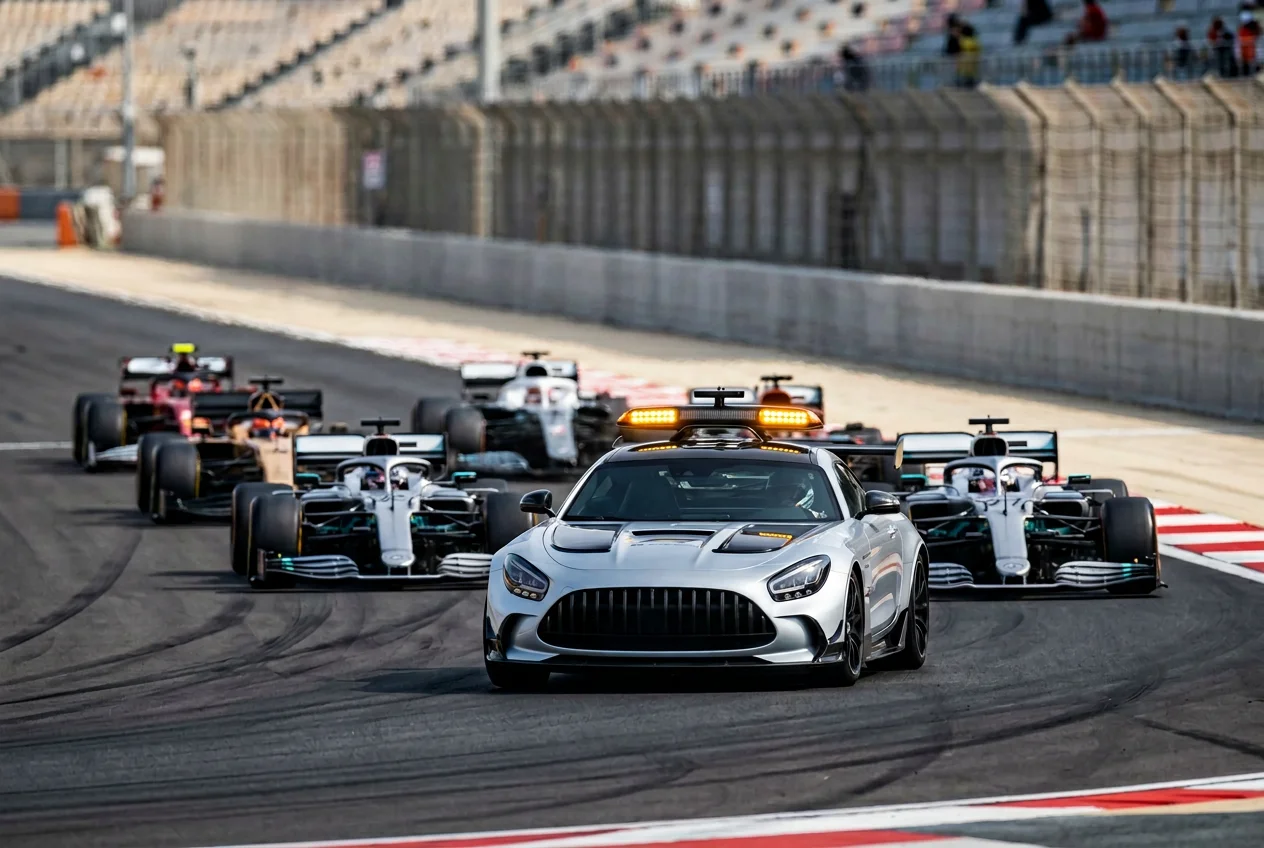
UK operators draw a hard line between the two in their settlement rules. A full safety car is a physical deployment of the Mercedes-AMG GT4 Black Series on track, leading a bunched-up field. A virtual safety car is a pace-restriction protocol governed by delta times, with no physical car on circuit. Pre-race markets phrased as “safety car yes/no” almost universally pay only on a full deployment. A VSC alone does not trigger settlement.
This matters because VSCs are issued more frequently than full deployments. A debris flag in sector two might earn 90 seconds of VSC and never escalate. On the bet slip, that’s a loss, even though the broadcast looked safety-car-coloured for a minute and a half. Live in-play markets sometimes carry a separate “safety car this race” tile that includes VSC; that one is operator-specific and worth checking before you stake.
The lesson I drill into anyone I help: read the rules tab on whichever UK book you use before the lights go out, not after the race. The dispersion between operators on VSC inclusion is real, and it’s part of the same broader pricing variance that gives line-shopping its edge across the F1 calendar. For a deeper read on how those in-play windows actually open and close, I’d point you to the early signals that warn a safety car is about to be deployed.
See also: gauge crowd sentiment on F1 prediction markets before placing your bet.
Questions UK punters ask about safety car betting
Two questions arrive almost weekly, and they’re the ones worth covering directly because the answers shape how the rest of the market reads.
Does a VSC count as a safety car for settlement?
On most UK pre-race safety car markets, no. A virtual safety car is a delta-time pace restriction and does not deploy the physical car. Settlement on a full deployment only is the default rule across nearly every UKGC-licensed book, but some operators offer a separate in-play tile that includes VSC events. Always read the market rules before you stake.
Which 2026 circuit has the highest SC probability for first-year bettors?
Singapore is still the safest mechanical bet for a yes-SC wager on historical data, with a 100% deployment rate across the entire life of the Marina Bay race. Monaco sits at roughly 70% across its last 10 runnings, and Canada is in similar territory. Bahrain is the corrective: priced low for a reason, and worth fading when the market drifts it shorter than 5/1.
