
 Available in US
F1 Sprint Race Betting: Format, Markets and Why Sprints Pay Differently
- Why sprint weekends rewrite the betting playbook
- The sprint weekend format from a betting perspective
- Sprint-only markets and how they price differently
- Why sprints introduce more variance, not less
- The 2026 sprint calendar and what the six rounds mean
- The sprint betting questions worth answering directly
Why sprint weekends rewrite the betting playbook
The first sprint weekend I traded was a £30 loss on a Saturday race that took 28 minutes to complete and left me with no time to react. That was the moment I learned that everything I knew about race-week pace mapping needed reworking. Sprint races don’t behave like miniature Grands Prix. They have their own variance signature, their own tyre arc, and their own pricing inefficiencies — and the markets that work over 60 laps frequently don’t work over 24.
The format has earned its place. Among F1 fans surveyed in 2025, 78% want sprint weekends to remain part of the calendar, and the schedule has expanded to six rounds in 2026 — Shanghai, Miami, Canada, Great Britain, Netherlands and Singapore. The 2025 Belgian Grand Prix sprint round drew more than 80 million viewers globally, the largest TV audience of the season. The audience clearly enjoys the compressed drama. What the audience doesn’t necessarily see is how that compression changes the underlying probability structure of the markets.
The differences are small per market, but they compound. Anyone treating a sprint weekend with a Grand Prix mental model is paying a tax they don’t need to pay.
See also: f1 bet for sprint and main race strategies.
The sprint weekend format from a betting perspective
The format runs in this order: free practice on Friday morning, sprint shootout on Friday afternoon, the sprint race on Saturday morning, and then qualifying for the Grand Prix on Saturday afternoon followed by the Grand Prix on Sunday. Parc fermé conditions kick in from the start of the sprint shootout, which means teams have a single one-hour practice session to nail their setup for the whole weekend.
That last point is the one that shapes the markets. Setup-change penalties hang over every team for the duration of the weekend, and teams that don’t get FP1 right pay for it across four sessions, not one. A car that’s off-pace in Friday practice carries that deficit through to Sunday afternoon, with limited recovery options. From a betting perspective, that makes FP1 readings unusually informative on sprint weekends — far more than on standard rounds.
The sprint shootout itself runs in three abbreviated qualifying phases: SQ1, SQ2, SQ3, on a defined compound rule that mandates softs in SQ3. The shorter run windows compress the timing of each driver’s best lap into a narrower band, which means traffic dependency on the in-lap and the out-lap matters more. Quieter sectors of track at the wrong moment in SQ2 can knock a Q3-capable car out by tenths.
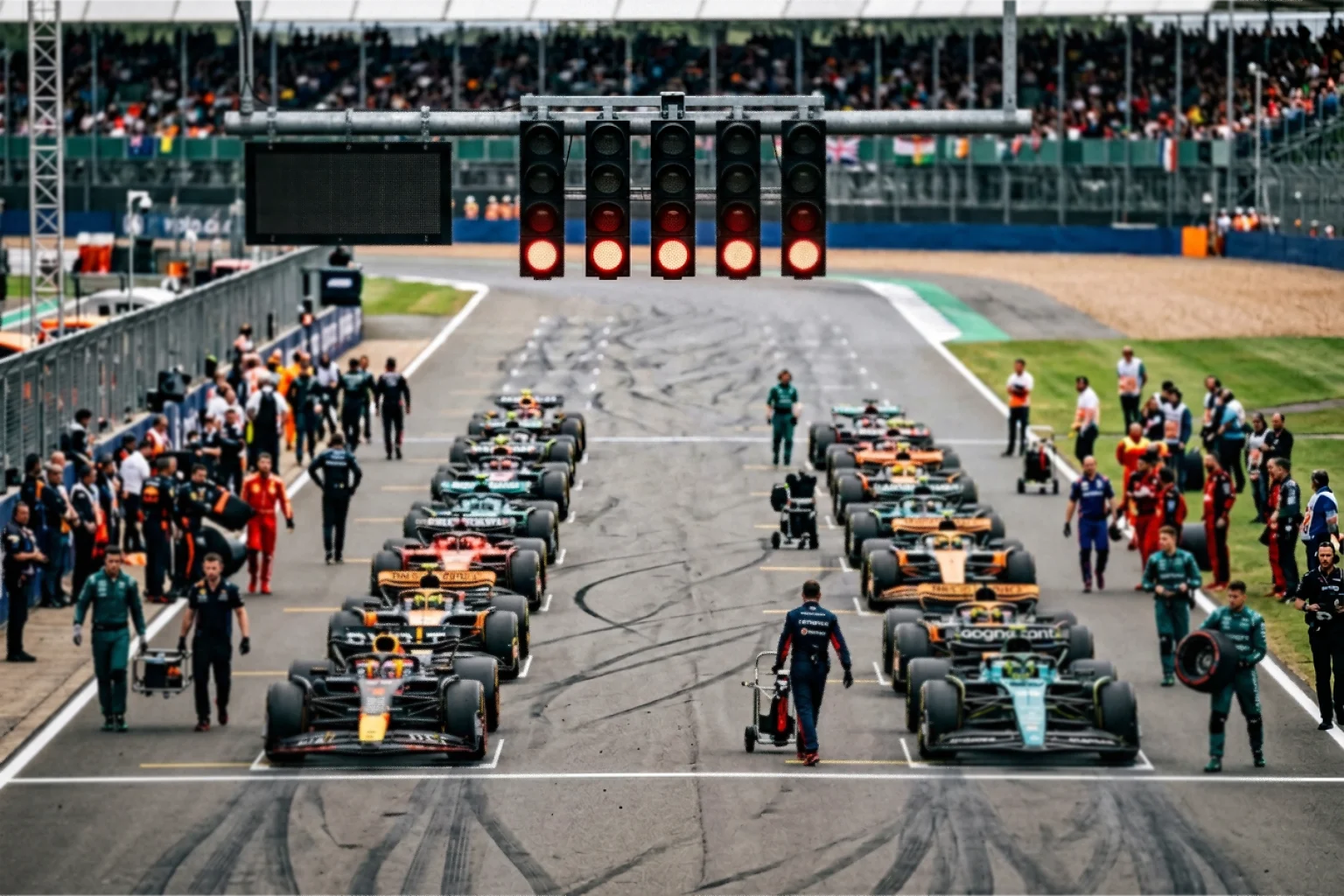
The sprint race itself is short — usually 100 kilometres or about 24 laps depending on the circuit — and is run with mandatory hard or medium compounds depending on regulations for that season. No mandatory pit stop, no significant tyre degradation in most cases. The strategic variables that dominate Sunday racing are mostly absent. What’s left is pace and start performance, and that’s it.
Sprint-only markets and how they price differently
UK operators that price sprint markets independently from race markets are the ones worth shopping. Some books just port the race-day market onto the sprint with adjusted odds, which produces messy pricing. The cleanest operators offer a discrete sprint winner, sprint podium, sprint fastest lap, and sometimes a sprint H2H series with different odds from the Sunday equivalents.
Sprint winner is the headline market. Pricing tends to over-favour the polesitter from the sprint shootout, which on first principles makes sense — pole carries a bigger conversion premium in a 24-lap race than in a 60-lap one. But the operators sometimes overshoot the conversion bonus, and a clean second-place sprint shootout qualifier can be priced longer than the actual pace data suggests.
Sprint podium is where I take more positions. Three positions out of 20 cars, in a race where overtaking matters more than strategy, means the implied probability per car is more reactive to the pace order than to anything more nuanced. Cross-operator dispersion on sprint podium is consistently wider than on Grand Prix podium across the same weekend, and that gap reflects market thinness rather than mispricing on my part. Sprint markets simply don’t attract the same volume of public money, so the books update slower and dispersion grows.
Sprint fastest lap is the market I avoid. The compressed format means the soft-tyre advantage gets compressed too, and most sprint races see fastest lap set by the leading car in the closing laps as a routine matter. The implied probability rarely offers value outside of safety-car-affected races.
Why sprints introduce more variance, not less
The temptation is to assume that a shorter race must be lower variance. The reverse is true, and the structural reason is interesting enough to be worth a paragraph of its own.
In a 24-lap sprint, opening-lap incidents have nowhere to wash out. A first-lap contact that costs three positions in a 60-lap race might be recovered over the remaining 57 laps. In a sprint, those three positions are essentially fixed for the rest of the running. Recovery drives don’t exist in a meaningful sense over 100 kilometres. That single dynamic shifts the variance of every grid-based market upward.
Drivers tend to be more aggressive too. The reduced points haul per sprint round, combined with the absence of championship-decisive late-race strategy, means drivers take more risks at turn one. The pattern is visible in the data: first-lap incidents are statistically more frequent in sprint races than in equivalent Grands Prix at the same circuit.
For a UK bettor, the takeaway is two-fold. Stake sizes on sprint markets should be smaller than equivalent Grand Prix markets, because the variance per bet is higher. And longshot positions are structurally more attractive — a 25/1 sprint podium price on a fourth-row qualifier is closer to fair than a 25/1 race podium on the same driver, because chaos finds the longshot more frequently in 24 laps than in 60.
The 2026 sprint calendar and what the six rounds mean
The six 2026 sprint rounds are Shanghai, Miami, Canada, Great Britain, the Netherlands and Singapore. Each of them brings a different character to the format, and a betting framework that treats them uniformly leaves money on the table.
Shanghai is the season opener for sprint weekends and the round where teams will have the most untested setup data. Variance is highest. Miami is a layout that rewards traction zones and slow-corner confidence, and the sprint format compresses the strategic differentiation that usually decides Sundays there. Canada has a long pit straight and a tight final sector, which makes opening-lap chaos more likely than at most circuits — sprint format amplifies that. The British round at Silverstone introduces home-driver bias on top of sprint variance. The Netherlands at Zandvoort is a narrow track with limited overtaking, which means sprint pole carries an even larger conversion premium than usual. Singapore is the season’s volatility outlier, with a 100% historical safety car rate on the Grand Prix and an underexplored sprint history that will reset much of the priced-in expectation.
The expansion has been politically debated within the sport. Mohammed Ben Sulayem, who runs the FIA, has framed it this way: “Stefano is a good friend, we speak five times a week, but I also always consider the additional burden on our staff. They already travel a lot, and it’s very tiring to get more races”. That points to the operational ceiling on further expansion, but the six-round 2026 calendar gives UK bettors a meaningfully larger set of sprint-specific opportunities than any prior season. A read on how Spa’s weather-soaked sprint dynamic produces specific market edges is a good companion to this article for anyone trading sprint weekends.
See also: lock in profits mid-race with our F1 cash out guide for UK bookmakers.
The sprint betting questions worth answering directly
Do sprint races count for the Drivers" Championship?
Yes. Points are awarded for the top eight finishers in the sprint race on a sliding scale, and those points contribute to both the Drivers" and Constructors" standings. The points haul is smaller than for the Grand Prix itself, but the cumulative effect across six rounds in 2026 can swing a tight championship by meaningful margins, which is worth factoring into ante-post title positions.
Why are sprint odds wider than main race odds?
Sprint markets attract less volume of public money than Grand Prix markets at the same weekend, which means UK operators update them more slowly and dispersion between books is consistently wider. The shorter race format also produces higher variance per outcome, which the books price defensively. Both factors combine to leave more frequent gaps between operators on sprint pricing than on Sunday race pricing.
