
 Available in US
F1 Tyre Strategy Betting: Pit-Stop Markets and Compound Calls
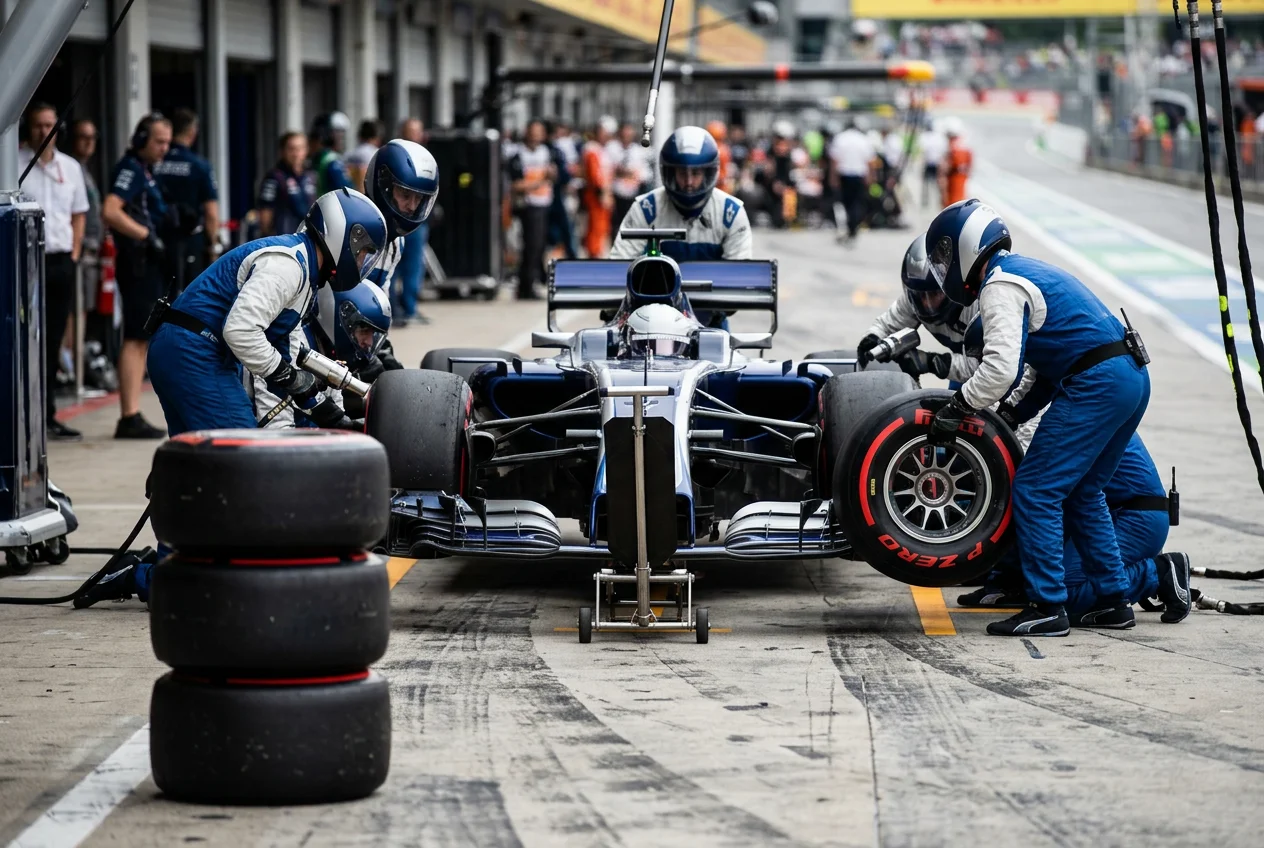
- The market most punters never look at
- Compounds and degradation: the base layer of every strategic call
- One-stop versus two-stop: where the books get it wrong
- Undercut and overcut markets — where operators get specific
- Wet-to-dry tyre flips and the chaos that creates
- The tyre strategy questions punters actually ask
The market most punters never look at
Ask a casual F1 bettor about pit-stop markets and you’ll usually get a polite blank stare followed by something about race winners. Ask the same question to anyone who’s run a serious staking plan across multiple seasons, and you’ll get a shopping list of operators, market names, and historical lines. Tyre strategy markets are the quietest source of consistent value on the F1 calendar, and the gap between the two groups of punters is one of the more interesting inefficiencies in the sport.
The reason these markets stay quiet is structural. They don’t draw the casual eyeballs. The 90% of F1 fans surveyed who say they’re emotionally invested in race outcomes are mostly investing that energy in the winner, the podium, and whichever driver they personally follow. Pit-stop count and compound markets demand a different attention profile — they require you to think about the race as a strategy puzzle, not a story.
That attention asymmetry creates pricing dispersion. The 5-15% spread between UK operators that exists on every F1 market tends to sit at the higher end of that range on tyre strategy lines, because there’s less public-money flow to drag prices into agreement. The opportunity for sharp punters is exactly there, in the markets that the public ignores.
See also: f1 bet for data-driven race strategy insights.
Compounds and degradation: the base layer of every strategic call
Pirelli’s five-compound range — C1 through C5 — runs from hardest to softest, and the three compounds nominated for each race weekend are drawn from that range based on circuit characteristics. The selection is announced weeks in advance, which means the strategic playbook for the weekend is partly visible before the cars even arrive.
The degradation profile of each compound is the input most punters underweight. Soft compounds give peak grip for a narrower window before falling off a cliff. Medium compounds offer a slower performance loss across a longer stint. Hard compounds take longer to come into operating window but, once warm, hold up better than the others across high-mileage stints. Those profiles interact with circuit characteristics in ways that the books often handle conservatively, leaving room for sharp positioning.
Bahrain and the Singapore weekend behave very differently in degradation terms despite both running in hot conditions. Bahrain’s smooth tarmac means even softs can run 25-plus laps in a clean race. Singapore’s surface and street-circuit kerbs chew through softs in 10-12 laps. A “one-stop versus two-stop” market priced identically on both weekends would be misvalued; in practice operators recognise the difference, but they don’t always price it precisely, particularly on the second-tier compound choices.
One-stop versus two-stop: where the books get it wrong
The one-stop versus two-stop market is my favourite annual hunting ground. UK operators offer it under various names — sometimes “winner number of stops”, sometimes “pit stop count” — and the lines move on factors that aren’t always priced cleanly.
The book’s default assumption for most circuits is a two-stop strategy. That’s the safe default, because two-stop is the strategic baseline in modern F1 across the majority of races. The mispricing appears when conditions push the race towards one-stop in ways the book hasn’t fully digested. Cool track temperatures, low overtaking probability, and high safety car probability all push the strategic optimum towards one-stop, because each variable reduces the marginal advantage of fresh tyres.
Singapore is the textbook example. The combination of a 100% historical safety car deployment rate, hot track temperatures that punish fresh-tyre advantage, and slow average speeds that compress strategic differentiation means one-stop strategies are actually the median outcome at Marina Bay across the modern era. UK operators that price one-stop yes-or-no symmetrically — implying a 50/50 split — are leaving genuine value on the table when the historical base rate is closer to 60/40 in favour of one-stop.
The same logic applies to the cold-weather races. Canada in early summer, Spa in mixed conditions, and Suzuka in autumn all push towards one-stop more than their dry-weather base rate would suggest. The market often takes a race or two each season to catch up to the strategic reality, which is the window where careful positioning pays.
Undercut and overcut markets — where operators get specific
The undercut and overcut markets are the deeper tactical layer of tyre-strategy betting. UK operators offer them under names like “first to pit”, “head-to-head pit stop position” and “first pit stop lap range”. The mechanics are interesting and the pricing is sometimes genuinely loose.
The undercut is the strategic play where a driver pits earlier than their competitor, gains time on fresh tyres in two clean out-laps, and emerges ahead of a competitor who pits later. It works at circuits with high tyre wear and meaningful pit-lane time loss, where the fresh-tyre advantage outpaces the pit-stop deficit. The overcut is the opposite: stay out longer, run hard in clean air, then pit and rejoin ahead. It works at low-deg circuits where fresh tyres don’t gain much.
The mispricing comes from operators handling these markets with templated pit-window assumptions. The book’s algorithm sometimes places “first to pit” at evens between two teammates when the strategic optimum clearly favours one of them based on starting tyre and grid position. A driver starting on softs from sixth has a structurally higher undercut probability than their hard-compound teammate starting from eighth. That asymmetry doesn’t always show in the pricing.
Mario Isola, who runs Pirelli’s motorsport programme, has spoken often about how the warm-up window of a fresh tyre interacts with track position. The relevant takeaway for betting is that a fresh-tyre out-lap at a hot circuit produces a smaller undercut gain than at a cooler one, because the tyre takes longer to come into its grip window. That’s the kind of structural detail the books model imperfectly, particularly on weekends where the weather forecast shifts after the lines were initially set.
Wet-to-dry tyre flips and the chaos that creates
The single most volatile sub-market in F1 betting is the wet-to-dry compound flip. The drying-line window — when intermediates start losing performance against dry slicks on the racing line — opens a strategic period where any decision is high-stakes and timing matters more than tyre choice.
The signal that the inter-to-slick window has opened is visible in the lap times: a sustained acceleration in lap pace across most of the field over consecutive laps, while the broadcast camera shows a visibly drying racing line. The first driver to gamble on slicks usually loses a lap to those who wait, unless the gamble is timed within a 90-second window of the actual crossover. Get it wrong by 30 seconds either way and the cost is structural.
The betting expression of this dynamic is the “first to pit for slicks” market, where it’s offered. UK operators that carry this market price it based on driver-specific risk profile, which means certain drivers attract shorter prices than the field. The implied probability calculation is messy and the operators don’t always get it right. Identifying the drivers who’ve historically nailed the inter-to-slick timing — and backing them at modest stake sizes when the wet-to-dry window is forecast — has been a respectable longshot edge over the seasons I’ve tracked it.
The same fresh-tyre timing logic shapes how fastest lap markets settle in the closing laps of dry races, which is the natural companion sub-market for anyone who’s already paying attention to tyre strategy on Sunday afternoons.
See also: know the warning signs before a safety car with our safety car trigger signs guide.
The tyre strategy questions punters actually ask
Are one-stop strategy bets settled on official lap count?
Almost always yes — most UK operators settle pit-stop count markets based on the FIA"s official timing record of pit-lane entries by the relevant car. Lap completions don"t matter; the count is the number of pit-stop transactions during the race. The edge case is a drive-through penalty or stop-and-go, which some operators count as a stop and others don"t. Read the market rules before you stake.
Do UK bookmakers offer pit-stop count markets?
Most do, though the depth varies meaningfully. Larger UKGC-licensed books offer pit-stop count as a routine race-specific market with one-stop, two-stop, three-stop-or-more brackets. Smaller operators sometimes only offer it on the headline race weekends. The pricing dispersion between books on this market sits at the upper end of the 5-15% range typical for F1 markets, which is why line shopping pays particularly well on tyre strategy lines.
