
 Available in US
In-Play F1 Safety Car Trigger Signs: Reading the First 20 Laps
The five-second window that decides the bet
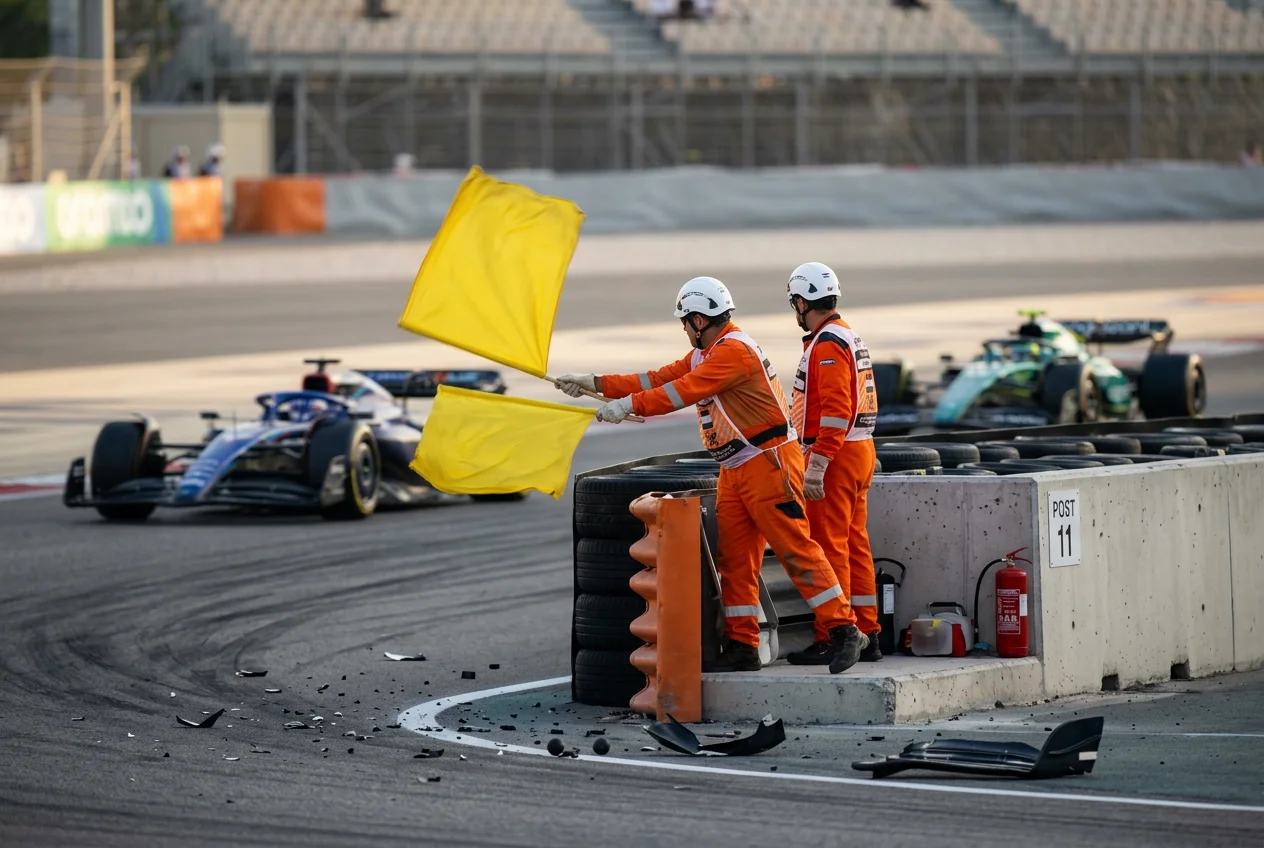
The fastest in-play decision I’ve ever made cost me 45 seconds of dithering and a 7/2 line that vanished while I was still typing. The race was Suzuka. The signal was a yellow sector at Spoon Curve in lap eight. I knew it was likely a safety car. I checked the broadcast feed first, watched the marshals walking onto the run-off, then opened the betting app — and by the time I’d loaded the bet slip, the line had moved from 7/2 to 6/4 and continued moving. The opportunity was gone before the safety car was even officially declared.
That race taught me the workflow I still use today. In-play safety car markets at UK books move on operator data feeds that update faster than the broadcast picture. The window between “something is happening” and “the market reflects it” is genuinely measured in seconds, not minutes. Live in-play betting accounts for roughly 70% of sports betting gross gambling yield across most of Europe, with Great Britain a little below that average, and a meaningful slice of that activity is exactly this kind of micro-window decision-making.
The bettors who win these markets are not the fastest typists. They are the ones who’ve worked out which signals matter before the race starts, so the decision is already made the moment the trigger appears.
See also: f1 bet for live race situation analysis.
Early-race signals that precede most opening-stint safety cars
Opening-lap incidents follow a recognisable rhythm at most circuits, and the signals show up in a specific order: yellow sector flag, debris commentary on the broadcast, marshal movement onto the track edge, then official VSC or full SC declaration. Each signal precedes the next by anywhere from 8 to 25 seconds, depending on the operator and the circuit.
The signals I watch in the first 20 laps are mechanical and ranked by how predictive they’ve been across the seasons I’ve tracked. Gravel saves are the first one. A car running deep into a gravel trap on the opening lap — even one that rejoins cleanly — flags the run-off as compromised for the next several laps. Operators don’t always price this into the SC market immediately, and the implied probability shift between the gravel save and the official VSC declaration can be worth a meaningful position if you’re already monitoring the relevant in-play tile.
The second signal is first-lap contact at street venues. Any wheel-to-wheel contact in the opening sector at Monaco, Singapore, Baku or Jeddah has historically converted to a full safety car at well above 70% rate. The broadcast usually catches the contact on a replay 30 seconds after it happens. The market sometimes catches it faster, sometimes slower. The arbitrage window is the difference between those two response times.
The third early-race signal is unusual tyre commentary. If lead commentary mentions a graining issue or warm-up problem in the opening five laps, that signal almost always precedes a strategy-driven incident in the following ten. Pit-window scrambles produce sloppy out-laps, and sloppy out-laps produce off-track moments. Listening to the broadcast for tyre keywords is more useful than watching the screen during opening-lap settling.
Mid-race flips and where the second SC window opens
Most punters watch the first 10 laps closely and then drop their attention until the final 10. That middle window — laps 20 to 50 — is where the second major safety car cluster lives, and it’s where in-play workflow really pays.
The signal cluster in the mid-race window is different from the opening laps. Opening incidents come from race-start chaos. Mid-race incidents come from tyre cliffs and pit-window scrambles. Both are predictable to a meaningful degree, and both produce specific in-play market movements that careful punters can take advantage of.
The tyre cliff is the most reliable mid-race trigger I’ve tracked. When the leading car’s lap-time delta stretches by more than half a second on a single lap, the field is about to enter the pit-stop window. Pit-window scrambles produce wheel-to-wheel contact during the under-cut and over-cut runs that follow, and that contact is the trigger. UK operators that offer safety-car-yes markets often have these priced based on the historical full-race rate, but the implied probability during the active pit-window is meaningfully higher than the race-average rate.
The other mid-race signal is the slower team’s first stop. A back-of-grid car pitting early — earlier than the natural strategy window suggests — usually indicates either a damaged car or a one-stop strategy attempt. The damaged-car scenario is the one to watch, because that car becomes a moving incident risk for the laps immediately following its return to the racing line. Watching for unexpectedly early stops from teams that don’t typically attempt aggressive strategy is a reliable mid-race radar.
Weather-correlated safety car clusters
The four weather-correlated circuits — Spa, Suzuka, Interlagos, and São Paulo’s broader Ayrton Senna complex — each have an in-play signal pattern that’s distinct from dry conditions. The principle is the same as the structural circuit base rates: most dry-condition signals also apply in the wet, but the wet conditions add a second layer of signals that don’t exist when the track is dry.
The wet-specific signals are intermediate-tyre wear patterns, drying-line confusion in the second sector, and the chaotic outbreak of slick-tyre risk-takers in the pit window. Each of these has its own in-play tell. Intermediate wear shows up as climbing lap times across the entire field rather than just one car. Drying-line confusion shows as wide cross-line variance — some drivers gain three seconds while others lose two on the same lap. Slick-tyre risk-takers produce off-track moments at predictable corners that are sequentially the first to dry out.
I keep a simple paper note during wet races: dry lap delta, wet lap delta, and the third column is “who took inters first”. The first slick-tyre attempt at Spa or Suzuka triggers the highest-implied-probability safety car window of the race, and the market often lags that signal by 30 to 90 seconds depending on the operator. The arbitrage in that window is the cleanest in-play F1 betting opportunity I know.
The feed latency trap and how to avoid it
This section is the one that costs careless punters more than any other in-play F1 lesson, so it’s worth a direct paragraph. The television broadcast you’re watching is on a delay of anywhere from 4 to 12 seconds against the timing data the operator’s trader is using to set the line.
What that means in practical terms is brutal. If you see a debris flag on your screen at 14:32:15, the operator already saw the same signal at 14:32:05 — or earlier, if they’re using a direct telemetry feed. The market has moved before your eyes have seen the trigger. Trying to react faster than the broadcast is not the strategy. The strategy is to anticipate triggers before they happen by reading the circumstantial signals — pit-window timing, tyre cliff arrival, weather changes — and to have a position pre-staked before the broadcast catches the actual incident.
UK operators differ on how aggressively they freeze in-play SC markets when the trigger fires. Some books freeze the market for 90 seconds after any yellow flag, allowing only outright SC declarations to settle the line. Others leave the market open at adjusted odds during VSC windows. The difference matters for staking discipline — the books that freeze early are the ones where pre-trigger positioning matters most, and those are the ones I prioritise for in-play betting.
This same broader workflow connects to the way pit-stop and compound markets respond to mid-race chaos, because the safety car windows reset every strategic assumption the books had baked into their compound-choice pricing.
See also: a points finish bet often swings on safety cars — explore our F1 points finish bet guide.
Questions in-play punters ask about safety car markets
How fast do bookmakers freeze SC markets?
Most UK operators freeze the pre-race safety-car-yes market within five seconds of an official VSC or full deployment declaration, and some freeze on a yellow flag in any sector. In-play markets that include both SC and VSC tend to stay open during VSC windows at adjusted odds. The variation across operators is meaningful, which is why anyone serious about in-play SC betting needs to test their preferred books in advance.
Which UK bookmakers treat a VSC as a partial settlement event?
The handling varies more than punters expect. Some operators settle the in-play safety-car market on a full deployment only, treating VSC as a non-event for that market regardless of duration. Others split the market and offer separate pricing for VSC and full SC. A small number price a third category for "any neutralisation" that includes both. Read the operator"s rules tab before you stake; the dispersion is wide enough that careful market-by-market checking pays meaningfully over a full season.
