
 Available in US
F1 Betting Line Shopping UK: Why 5-15% Price Gaps Define Profit
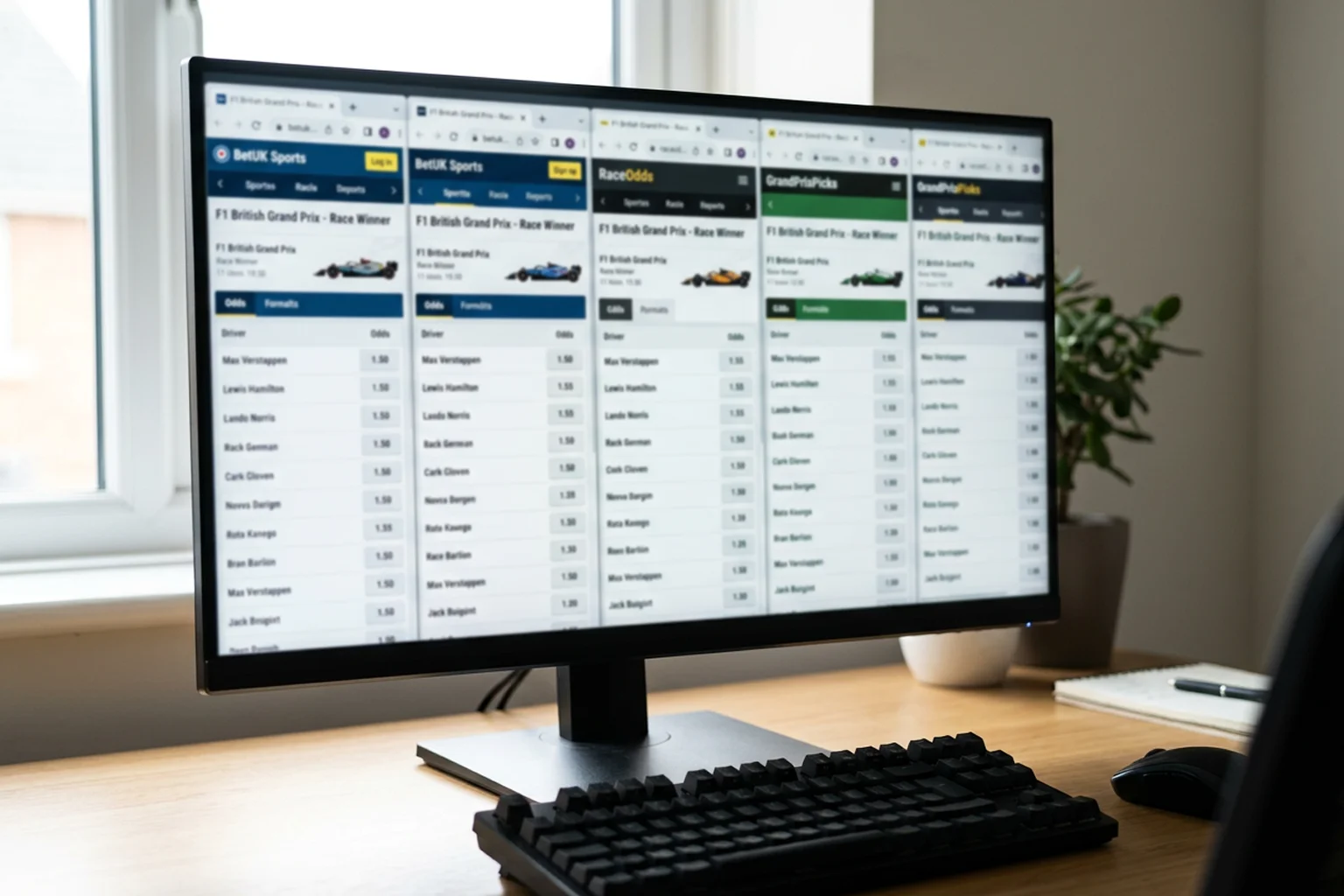
The single discipline that separates breaking even from winning
If I could only teach a new UK F1 bettor one habit, it wouldn’t be staking discipline, race analysis, or value identification — though all three matter. It would be line shopping. Across eight seasons of tracking my own results, the punters I know who are profitable over multi-year horizons are the ones who never place a bet without checking at least three operators first. The punters who break even or lose money are the ones who reflexively place every bet at their default app without comparison. The discipline is that mechanical and that consequential.
The reason is statistical. UK F1 markets show typical price dispersion of 5 to 15 percent between operators on the same outcome, depending on the market depth and the time relative to race start. A pre-race race winner price might be 9/4 at one operator and 11/4 at another. That difference compounds across every bet placed. Over a season of 200 bets, taking the worse price each time produces a portfolio outcome that’s structurally below what taking the best available price would deliver, and the gap is large enough to be the difference between a positive and negative season.
What makes line shopping work in practice is not exotic. It’s repetitive comparison across a set of trusted UK operators, applied consistently to every position. The mechanics are simple. The discipline of actually doing it on every bet is the part that separates the punters who genuinely line-shop from the ones who tell themselves they do.
See also: f1 bet for line shopping and timing strategies.
Where the price gaps actually appear
The 5-to-15 percent dispersion is an aggregate figure. The actual gap on any specific F1 market depends on factors that are worth understanding because they tell you where the line-shopping edge is largest.
Outright markets — drivers’ and constructors’ championships — typically show the widest dispersion among operators. The reason is operator confidence in their own pricing model. Outright markets require modelling assumptions over a long horizon, and different operators reach different conclusions about implied probabilities. The result is meaningful dispersion that can run to the upper end of the 5-15 percent range, particularly early in the season when the championship picture is genuinely uncertain.
Race winner markets tend to show narrower dispersion in the days immediately before a race, because the operators have converged on similar implied probabilities through market pressure. The dispersion widens earlier in the week when the post-race adjustment from the previous round is still being absorbed by different operators at different speeds. Tuesday and Wednesday tend to show wider dispersion than Friday and Saturday on the same race.
Prop markets — first retirement, fastest lap, safety car appearance — show the most variable dispersion. Some operators price prop markets carefully with their own internal models. Others apply rough heuristics that can produce significantly mispriced lines on specific markets. The line-shopping edge on prop markets is larger than on headline markets, but the variance per bet is also higher, which means the staking discipline has to account for the additional risk.
In-play markets show the most dynamic dispersion. Different operators update their in-play prices at different speeds and with different sensitivity to specific race events. An operator slow to update after a safety car deployment may offer a price 10-20% out of line with the post-deployment fair value, but the window before the operator catches up is typically very short — sometimes only seconds. Live line shopping requires faster decision-making than pre-race comparison, and is genuinely difficult to do well without specialised tools.
Aggregators versus direct comparison
The practical workflow for line shopping splits between aggregator-based comparison and direct operator comparison. Each has structural advantages and disadvantages worth understanding before settling on a workflow.
Aggregator websites — sites that scrape live prices from multiple UK operators and present them in a comparison table — are the time-efficient option. A well-built aggregator lets a punter see the best available price across 10 or 15 operators on a specific market in seconds. The structural advantage is speed; the structural disadvantage is that aggregators don’t always reflect every promotional pricing offer, and they can lag the actual operator prices by anything from 30 seconds to several minutes depending on the scraping refresh rate.
Direct operator comparison — opening each operator’s app or website to read the price directly — is slower but produces more accurate real-time data. The direct comparison also captures operator-specific features that aggregators don’t always reflect, such as enhanced odds offers on specific markets, best-price-guaranteed promotions, or boost tokens applied to recent customers. The accuracy is better; the time cost is higher.
The practical workflow I use for pre-race positions is aggregator-first to identify the top three operators on a specific market, then direct comparison to those three to confirm the live price and capture any promotional pricing the aggregator missed. The combination produces close to the time-efficiency of pure aggregator workflow with close to the accuracy of pure direct comparison.
The Ladbrokes share of UK gambling pay-per-click market reached 36.8% in April 2026, making them the largest operator by search visibility. The scale doesn’t always translate into the best prices on every market — it means Ladbrokes will be at the top of most aggregator comparisons by default through brand prominence, but the actual best price on any specific F1 market may sit at a smaller operator that competes harder on price for that specific category. The aggregator workflow surfaces this by showing the actual price ranking rather than the brand prominence ranking.
Multi-account discipline and how to manage it
Effective line shopping requires holding accounts at multiple UK operators, and the practical management of those accounts is itself a discipline. The number of accounts a punter needs depends on the depth of their F1 betting activity, but the minimum useful number is probably four or five operators covering the major UK book categories.
The account setup should include at least one major established UK operator with consistent pricing across all F1 markets, at least one operator known for sharp prop market pricing, at least one operator with good outright market pricing on long-horizon ante-post positions, and at least one operator with reliable in-play pricing speed and stability. The exact identity of which operator fits each category shifts over time, but the categorical coverage is what matters.
The funding discipline matters too. Spreading a betting bankroll across multiple operator accounts means the per-account balance is smaller than it would be with a single operator, which is structurally helpful for variance management. The trade-off is that each operator’s promotional offers — first deposit bonuses, recurring promotions — are typically calibrated to single-account engagement, which means the multi-account punter sometimes captures less promotional value per pound of activity than a single-account punter would.
The administrative cost is real. Holding five operator accounts means five separate sets of login credentials, five separate deposit and withdrawal records, five separate sets of responsible-gambling tool configurations, and five separate identity verification processes. The administrative time investment is meaningful at setup and ongoing. For a punter whose annual F1 betting volume justifies that investment, the line-shopping returns more than offset the administrative cost. For a casual punter placing a handful of bets a year, single-operator simplicity is probably the right choice.
Account limits and stake restrictions
The structural issue that line-shopping punters eventually encounter is account limits. UK operators are commercial businesses, and consistently profitable customers — typically defined by the operator as customers whose betting patterns suggest sharp pricing or systematic edge identification — are commercially unattractive. The operator’s response is typically to restrict the customer’s maximum stake on specific markets, or in some cases across all markets.
The mechanics of account limits vary by operator. Some operators apply restrictions silently, leaving the customer to discover the limit by trying to place a stake larger than what the operator will accept. Others communicate restrictions explicitly through account messaging. The structural impact is the same: a customer whose stake is restricted to a level meaningfully below their normal pattern is effectively constrained out of value capture on that operator.
The pattern UK F1 line-shoppers tend to follow is to rotate stake intensity across operators rather than concentrating winning patterns at a single account. Placing the largest stakes at operators where the price is best on that specific market — rather than always at the same operator — produces a profile that’s harder for any single operator to flag as a sharp-betting pattern. The rotation is itself a form of structural discipline that extends the useful life of multi-account access.
The legal position is straightforward: account limits and account closures are at the operator’s commercial discretion under UK law, provided the operator complies with their UKGC obligations around fair treatment of customers and clear communication of any account changes. Customers who feel an account decision has been unfair can escalate through the operator’s complaints process and, ultimately, to the Independent Betting Adjudication Service.
The structural relationship between line-shopping discipline and broader bet-construction questions — particularly the each-way structure that’s often offered on F1 outright markets — is the natural next subject for anyone building out a complete UK F1 betting approach, and the specifics are covered in the dedicated guide to each-way betting on F1 outright markets and the trade-offs involved.
See also: apply line shopping at the Singapore Grand Prix where safety cars shape the odds.
Line shopping questions UK punters ask
Is line shopping allowed under UKGC rules?
Yes. Holding accounts at multiple UK-licensed operators and comparing prices before placing bets is entirely legal under UK law and entirely permitted under the UKGC regulatory framework. Each operator has the commercial right to set their own account limits, including restricting or closing accounts where their commercial judgement suggests it. But line shopping itself is a legitimate consumer-protection practice and is structurally supported by the open competitive market that UKGC licensing produces. UK punters should feel no hesitation about comparing prices across operators before staking.
Do aggregators show real-time F1 odds?
Aggregators show near-real-time F1 odds, but with refresh delays that vary from 30 seconds to several minutes depending on the scraping infrastructure and the operator"s data feed permissions. For pre-race line shopping, the delay is typically acceptable. For in-play comparison, the delay can be the difference between capturing a value price and missing it. The practical workflow most effective for serious line shopping is aggregator-first to identify the top operators on a market, then direct comparison to those operators to confirm the actual live price.
