
 Available in US
F1 Winning Margin Bet: How Seconds at the Flag Become Money
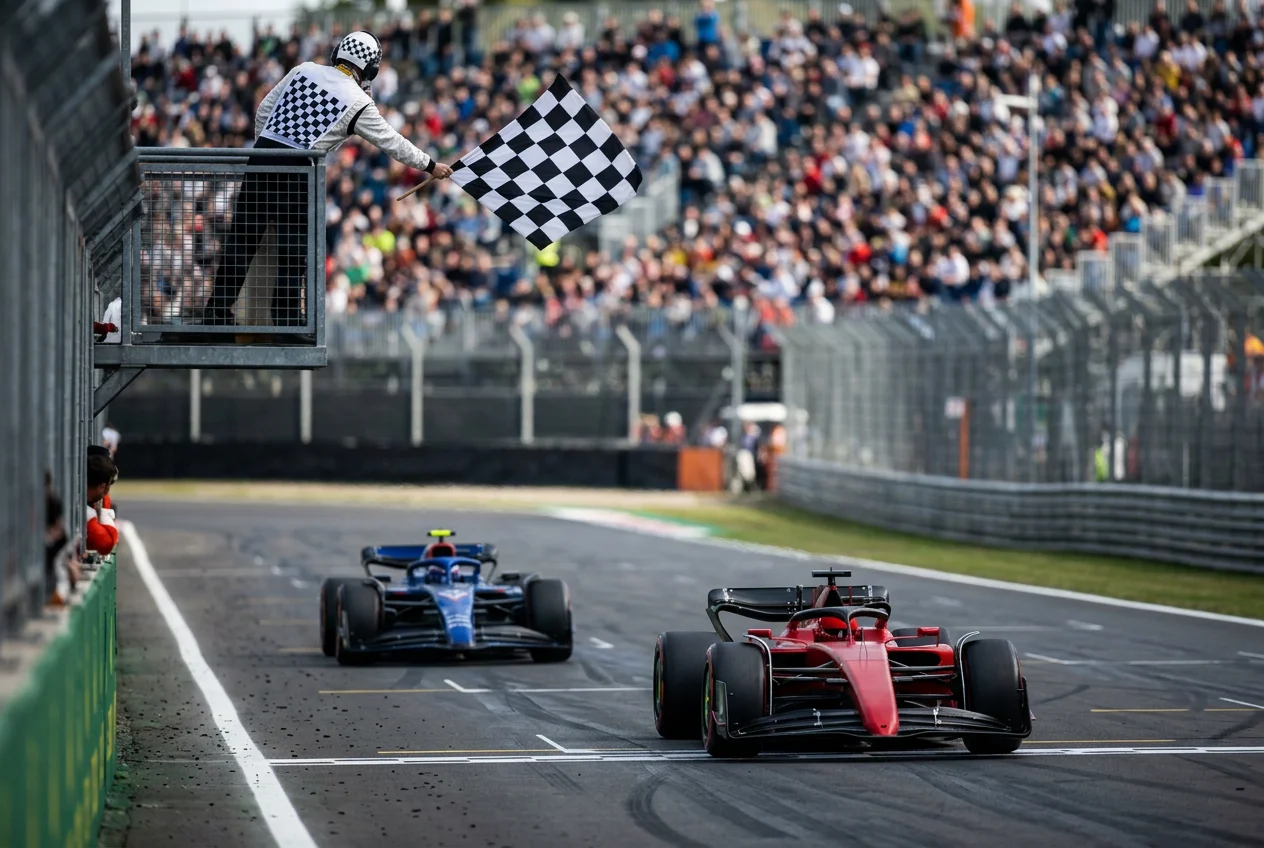
The market where the chequered flag is the smallest of variables
The winning margin market is one of the F1 betting structures I’d categorise as both technically interesting and practically demanding. The structure looks simple — pick the time gap between the race winner and the second-placed car — but the underlying probability distribution is complex, and the settlement rules at most UK operators have edge cases that have caught careful punters out repeatedly. The market rewards the bettors who understand the underlying race-pace dynamics; it punishes the ones who treat it as a guess.
The mechanical idea is straightforward. UK operators offer brackets of time differences — typically “less than 5 seconds”, “5 to 10 seconds”, “10 to 15 seconds”, and so on up to “over 25 seconds” — and the punter picks the bracket that they think the winning margin will fall into. The bracket boundaries differ by operator, the number of brackets differs by operator, and the implied probability across the brackets gives a useful read on each operator’s underlying expectation for the race.
What makes winning margin a strategically useful market is that it captures a different signal from race winner. Race winner is a binary outcome on driver identity. Winning margin is a continuous outcome on race pace dynamics. Two races that both produce the same race winner can have very different winning margins, and the underlying race conditions that determine the margin — safety cars, weather, strategic divergence, late-race incidents — are sometimes more predictable than the race winner itself.
See also: f1 bet for niche and high-value F1 markets.
The bracket structure and how implied probability flows
The typical UK bookmaker offers winning margin brackets at intervals of roughly 5 seconds, with the most-common-outcome bracket at the shortest implied odds. The implied probability distribution across the brackets gives a useful picture of what the operator thinks the race will look like.
A race with a clear pace favourite running in clean air at a non-overtaking circuit will typically have its largest implied probability concentrated in the upper brackets — “over 20 seconds” or “over 25 seconds” — because the historical pattern is for that combination to produce large winning margins. A race with multiple cars genuinely competing for the lead, with similar pace and frequent safety car intervention, will have its largest implied probability concentrated in the lower brackets, particularly “less than 5 seconds”.
The five-to-fifteen percent dispersion typical of UK F1 markets is wider on winning margin than on race winner, because operators differ more on their underlying race-pace models than they do on driver-level outright pricing. The line-shopping opportunity is correspondingly larger, and disciplined comparison across multiple UK operators on winning margin markets is one of the higher-EV exercises in F1 betting.
The bracket selection structure means a single race produces multiple separate value opportunities. A punter can take positions in multiple brackets on the same race, with the brackets selected based on which the operator has mispriced rather than which the punter thinks most likely. The bracket with the largest gap between operator-implied probability and the punter’s own fair-value estimate is the position-taking choice, not necessarily the bracket the punter thinks most likely to settle.
Track-specific winning margin patterns
The single most useful preparation for any winning margin bet is understanding the circuit-specific historical pattern. Different circuits produce structurally different winning margin distributions, and the underlying physics of each track shapes the distribution in predictable ways.
Singapore is the most distinctive case. The Singapore Grand Prix has had a 100% safety car deployment rate since 2008 — every single Singapore race in that period has involved at least one safety car. The race length is also typically near the two-hour time limit, which means safety car interventions compress the field and reset the winning margin clock multiple times during the race. The result is that Singapore winning margins are heavily concentrated in the shorter brackets — typically under 10 seconds — and the historical median margin is meaningfully lower than at most other circuits.
Monaco has a similar pattern through a different mechanism. The Monaco Grand Prix has a 73.9% safety car or virtual safety car deployment rate, and the circuit produces almost no overtaking under green conditions. The combination means the winning margin at Monaco is typically small — the leader can pull a gap, but a single safety car late in the race compresses it back to seconds. The historical median Monaco winning margin is among the shortest on the calendar, and the bracket distribution at UK operators usually reflects this with low odds on the “under 5 seconds” bracket.
Bahrain and Spain produce the opposite pattern. Both circuits favour the genuinely faster car and reward strategic execution by the dominant team. The winning margin distribution at these circuits is shifted toward the upper brackets, and races that develop early can produce 15-to-25 second winning margins routinely. The “over 20 seconds” bracket at Bahrain typically prices shorter than at most circuits, reflecting the historical pattern.
Monza and Spa sit in a middle category. Both circuits produce variable winning margins because the high-speed slipstream effects and weather variability can compress or stretch the lead car’s gap unpredictably. The bracket distribution at these circuits tends to be more evenly spread, and the operator’s confidence in any specific bracket pricing is correspondingly lower, which sometimes opens line-shopping opportunities.
Weather and safety car effects on the margin
The two largest variables affecting winning margin during a race are weather changes and safety car deployments. Both produce step-function changes to the margin rather than gradual evolution, and both are sometimes predictable enough in advance to produce winning margin betting edges.
Safety car deployments compress the field, which means the winning margin at the point of any safety car effectively resets to the closing distance to the second-placed car. A 25-second lead can become a 2-second lead in one lap, and depending on how late in the race the deployment happens, the leader may not have time to rebuild a meaningful gap before the chequered flag. The “less than 5 seconds” winning margin bracket is functionally a bet on a late safety car at any circuit, because that combination of events is the most reliable way to produce a tight margin from a previously larger one.
Weather changes work similarly but with more variability in direction. A rain shower mid-race can compress the field by forcing pit stops onto everyone simultaneously, but the actual effect on winning margin depends on how the rain interacts with each driver’s tyre management and strategic timing. The general direction is toward smaller winning margins on weather-affected races than on dry runs, but the variance is high enough that weather-driven winning margin bets are structurally riskier than safety-car-driven ones.
Weather forecasts in the days before a race are therefore a useful input to winning margin betting. A high-probability rain forecast for race day typically shifts the optimal winning margin position toward the shorter brackets, and the operator’s pre-race pricing may or may not have fully reflected the forecast. The lag between forecast updates and operator price adjustments is sometimes the value opportunity.
Value spots in the winning margin market
The structural value spots in F1 winning margin betting tend to concentrate in two scenarios. The first is when the operator’s bracket pricing is anchored to a historical baseline that doesn’t reflect specific current-season conditions. The second is when the operator’s response to a developing weather forecast is slower than the actual probability change.
The historical baseline anchoring is the more common case. UK operators typically build their winning margin pricing models from multi-year historical data on each circuit, with adjustments for current-season team performance. The model produces a default bracket distribution that’s broadly correct on average but may not capture short-term factors like a specific team’s recent upgrade or a specific driver’s current form. When the short-term factors point toward a different bracket distribution than the historical baseline suggests, the value opportunity exists across multiple brackets.
The weather-response case is more time-sensitive. A forecast that shifts toward higher rain probability in the 24 hours before a race produces structural pressure toward shorter winning margin brackets. UK operators differ in how quickly they update their pricing in response to forecast changes. The fastest operators may update within an hour of a significant forecast shift; the slowest may take 12 hours or more. The price gap during the response lag is the value capture opportunity.
The 5-to-15 percent typical F1 market dispersion is often at the upper end of the range on winning margin markets specifically, because the underlying modelling is harder and the operator confidence is lower than on headline markets. Line shopping across UK operators on winning margin is one of the highest-value applications of comparison discipline in F1 betting.
The closely related question of how qualifying betting produces value through its own structural patterns is the natural companion subject, and the dedicated piece on pole position betting and where Saturday beats Sunday for value covers the same disciplined approach applied to a different market category.
See also: tyre choices heavily influence gaps — read our F1 tyre strategy betting analysis.
Winning margin questions worth asking before staking
Is the margin measured at the lead car or last car?
The winning margin on UK bookmaker markets is measured as the time gap between the first-placed and second-placed cars at the moment the first-placed car crosses the finish line. The margin to lapped traffic or to cars further down the field is not used for settlement. Some operators offer alternative markets — "second to third margin" or "top three spread" — but the headline winning margin market is consistently first-to-second across UK operators. Always check the operator"s specific market rules if any ambiguity exists in the bracket description.
What happens to margin settlement after a red flag?
Red flag handling on winning margin markets varies by operator. The most common rule is that if a race is red-flagged and finishes under red-flag conditions — meaning the cars never restart — the winning margin is settled on the time gap from the last completed racing lap, not on the standing time as recovery vehicles work. If the race restarts after a red flag and continues to a normal finish, the winning margin is settled on the actual time gap at the finish. Operators differ on edge cases, so check the specific market rules before staking on races where red flag probability is elevated.
