
 Available in US
Monaco Grand Prix Betting Guide: Why Qualifying Pays More Than Race Pace
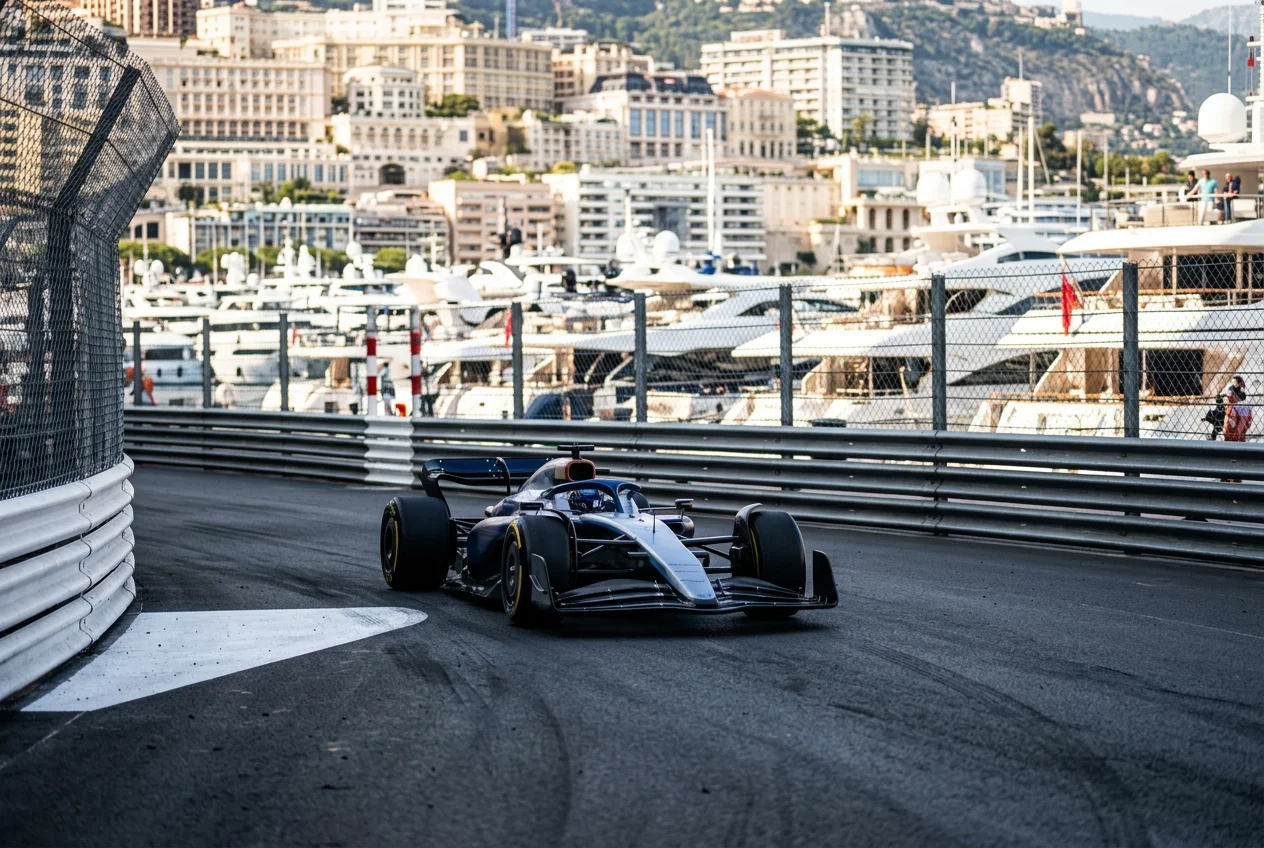
The race where Saturday afternoon decides Sunday’s payout
Monaco taught me, painfully, that race pace is almost irrelevant when overtaking is impossible. My first season trading this weekend, I built a model that weighted long-run pace at 60% and qualifying at 40%, and lost three units on a Sunday where the polesitter cruised home untouched. I rebuilt the model the next week with qualifying at 80% weight, and that version still runs.
The reason is mechanical. Monaco’s pole-to-win conversion rate is consistently among the highest on the calendar across the modern era, and the underlying cause hasn’t changed: there is nowhere to pass cleanly. Sainte Dévote, Mirabeau, the hairpin, the swimming pool chicane — every potential overtaking zone has either a wall or a corner exit that punishes any attempt that doesn’t land. The strategic implication for a UK bettor is direct: stake weight should follow the qualifying picture, not the race-pace picture.
That single recalibration is worth more on Monaco weekend than any other piece of analysis I can offer. The race-winner market behaves as a qualifying derivative more than as a race-day market, and the operators that price it as a pure race market leave value sitting on the table.
See also: f1 bet for a complete guide to Formula 1 wagering.
The character of a circuit that doesn’t pretend
The defining number about Monaco is its width, not its length. The track is 3.337 kilometres of public road, mostly two cars wide on the racing line and one car wide everywhere else. Modern F1 cars are wider than the design constraint the layout was ever drawn for, and that mismatch is the whole story.
What that geometry produces in betting terms is brutal: position lock from Q3 to the chequered flag, unless something breaks. The tunnel, often described as a low-light hazard, is actually the easiest section of the lap once a driver acclimates — the corner inputs are continuous and there’s no traffic. The hard sections are Mirabeau and the swimming pool, where wall-trust separates a brave Q3 lap from a clean one. A driver who is two tenths down through those corners in Q3 is starting two rows back, and at Monaco that two rows is functional eternity.
The qualifying premium is built directly into the calendar’s identity. Stefano Domenicali, asked about expansion pressure on the schedule, has been blunt: “we have already reached the limit”. Monaco is the place where that limit is most visible — a circuit that exists because of heritage rather than competitive-suitability metrics, and that’s precisely why its qualifying-heavy character has not been engineered away.
The qualifying markets worth your unit
Three markets carry the Monaco weekend for me: pole position, qualifying head-to-head, and top-three-in-qualifying. The race-winner market is downstream of all three.
Pole position is the cleanest single-event bet on the calendar at Monaco. There is no fuel mystery, no warm-up uncertainty across a full race distance, no tyre cliff to navigate. Q3 is one or two flying laps on the softest available compound with maximum engine modes, and the timing sheet at the end is the answer. Cross-operator dispersion on pole pricing is usually narrower at Monaco than at most rounds — the books know what they’re pricing — but a 5-15% spread between UK operators still appears, and disciplined line shopping captures real edge.
Qualifying head-to-head is where I take the most weight. Teammate H2H in Q3 is the closest thing to a pure driver-versus-driver assessment Formula 1 offers, and on a circuit where the car’s differences across the field are flattened by lap-length brevity, it is even sharper. A driver who’s been one to two tenths quicker than their teammate in FP3 long-run pace will usually carry that into Q3, and the price often doesn’t reflect it. UK books mispricing intra-team quali H2H is one of the most consistent edges I’ve tracked across five Monaco weekends.
Top three in qualifying is the bet for picking up a wide-priced longshot. Mid-grid teams occasionally produce a banker Q3 lap at Monaco — the geometry rewards driver bravery as much as machinery — and the implied probability on a mid-field car making Q3 top three is often half what the historical data suggests when their FP3 timing is read carefully. This is where I take my deepest longshot positions on Monaco weekend, in 0.2-unit stake sizes.
The safety car pattern that funds the weekend
Monaco has produced roughly 13 safety cars across its last 10 runnings — a probability hovering around 70% that the books still tend to under-price relative to that base rate. The pre-race safety-car-yes line at Monaco has been a quiet long-term winner for me, and the reason is structural.
Every DNF at Monaco is a road-blocker. Recovery vehicles can’t squeeze in under local yellow because there is no margin for them. When a car stops at Sainte Dévote or the swimming pool, the only mechanism to clear it safely is a full safety car. Permanent circuits absorb stopped cars under VSC routinely; Monaco rarely can. That distinction alone explains why Monaco’s deployment rate is roughly five times higher than Bahrain’s, despite both producing similar opening-lap incident rates in raw terms.
The actionable edge here is small but consistent: if the pre-race safety-car-yes line drifts above 5/6 in the days before the race, take it. Across the last decade, that line has been a winner more often than the implied probability suggests, with the only material drawdowns happening in dry, low-incident editions where every front-runner kept their car off the walls. Those are rare enough to ignore for staking purposes.
The favourites pattern and what it tells you
Monaco’s winners’ list reads heavily towards a small group of names, and that’s not coincidence. The circuit rewards specific skills — slow-corner confidence, wall-trust, and a willingness to lean on the kerbs in qualifying without breaking the floor. Some drivers acquire that profile after one or two visits; others never do. The historical pattern means that the betting market reflects driver-circuit affinity more strongly at Monaco than at most rounds.
For a UK bettor, that creates two ways to read the favourites list. Either back the known Monaco specialist at their honest price — knowing the historical record justifies it — or fade them when the price has gone too short in the days before the race and look for value at the second-tier names whose pole-ability is being underweighted by public money. Mid-grid podium spots at Monaco are historically rarer than at chaotic circuits, but when they do happen, they pay big.
The same qualifying-centric logic shapes every adjacent market, which is why I treat the broader framework for reading FP3 and Q1-to-Q3 pace as core preparation for Monaco weekend specifically. A Monaco bet without a clean read of Friday and Saturday pace is essentially blind.
See also: adapt your approach for live race action with our F1 in-play betting strategy.
The questions Monaco punters ask before lights-out
Why is pole position so important at Monaco?
Because overtaking is functionally impossible across most of the lap. Sainte Dévote, the hairpin, and the swimming pool all punish any attempted pass that doesn"t land perfectly, so the grid order from Q3 tends to be the race order at the flag unless safety cars reshuffle the running. Pole-to-win conversion at Monaco is consistently among the highest on the calendar, which means pre-race pole position pricing carries unusual implied accuracy on race-winner outcomes.
Can a mid-grid driver podium at Monaco?
Yes, and the historical record shows it happens just often enough to justify longshot positions when the implied probability drifts too far. The combination of a 70% safety car deployment rate, narrow track geometry, and DNF-friendly walls means mid-grid contenders occasionally pick up podium finishes when the front-runners falter. Stake sizes should stay small — typically 0.2 units or less — but the price on a mid-grid podium often runs longer than the structural base rate would justify.
